Showing posts with label EUR/USD Forecast. Show all posts

Sunday, October 3, 2010

EUR/USD Weekly Technical Forecast (Oct 4-8 2010)

The Euro had another amazing week, breaking significant levels every day. It now faces a wide variety of releases, with the rate decision in the limelight. Here’s an outlook for the European events and an updated technical analysis for EUR/USD.

EUR/USD Technical Analysis


The Euro began the week with a struggle between 1.3430 and 1.35, but then jumped above 1.3530 and traded in a range between 1.3530 and 1.37 (all lines mentioned last week as well), before breaking 1.27 and closing at 1.3790 – another impressing weekly gain of 300 pips.EUR/USD is now between 1.37 that provided resistance in the past week and also in April, and 1.3850 from above. This line supported the Euro in January, and then turned into a fierce resistance line.

Above, 1.40 is a round psychological number and also provided support in 2009. The next line of resistance is at 1.42, that provided support for the Euro during December 2009.

Higher, 1.4450 worked as resistance twice in 2009. It’s followed by 1.4580, a swing high in January, before the pair deteriorated quickly.

Looking down, 1.35-1.3530 is an area of support after working as resistance in the past week. It’s followed by 1.3430 that provided support in February and also recently.

Lower, 1.3267 is the next support line, after working as such twice in March and April, recently working as resistance. Below, 1.3110 is another line of support that later worked as resistance.

1.3050 is a minor line of support, after working as resistance. It’s followed by 1.2920 that capped the pair in September and 1.2730 which had the same role.

Note that since the beginning of September, EUR/USD is trading in a very steep uptrend channel (also marked in the graph). It will be interesting to follow this channel in the upcoming week.

I now turn from bullish to bearish on EUR/USD.

There are several reasons: European debt issues, which were reflected in the Anglo-Irish problems and demonstrations across the continent, cannot remain under the carpet for too long. The net dollar-short positions is at the highest levels since the summer of 2008 – the time when the Euro began collapsing. And I believe that even the Euro bulls can agree that a retracement is needed after scooping 1100 pips in a month.


EUR/USD daily chart with support and resistance lines marked. Click to enlarge:

eur usd forecast October 4-8

The Spanish credit downgrade and the problems in the Anglo Irish bank couldn’t stop the Euro. Net dollar shorts are at the highest levels since the summer of 2008. If everybody’s short, who’s left to sell? It will be interesting to see if Trichet says something about the currency after the rate decision. Let’s start:

  1. Sentix Investor Confidence: Monday, 8:30. This official survey of 2800 analysts and investors disappointed last month by dropping to 7.6 points. It’s now expected to climb up to 8.6 points, indicating stronger optimism.

  2. PPI: Monday, 9:00. Producer prices aren’t expected to follow consumer prices. The all-European figure is released after Germany and France release their own. Nevertheless, it tends to move the Euro. Monthly PPI is expected to rise by 0.2%, slightly slower than last month.

  3. Retail Sales: Tuesday, 9:00. After a significant drop of 0.9% four months ago, the volume of sales posted gains in the past three months. Also here, the data is released after the biggest countries have already published their own, but the figure tends to surprise. A 0.2% rise is predicted this time.

  4. Final GDP: Wednesday, 9:00. According to the initial release, Q2 was surprisingly good in Europe, with a 1% growth rate. Germany stood out with a whopping 2.2% growth rate. This 1% figure will probably be confirmed now. Surprises are rare with this publication.

  5. German Factory Orders: Wednesday, 10:00. Europe’s economic locomotive disappointed last month with big drop of 2.2% in the total value of orders. A rise of 0.9% is expected to provide a nice correction for last month’s fall.

  6. German Industrial Production: Thursday, 10:00. Complementing on factory orders, this related figure also disappointed last month with a modest 0.1% rise. A stronger rise is expected now – 0.4%. This comes very close to the rate decision.

  7. Rate decision: Thursday, 11:45.  The president of the ECB sees inflation gradually rising in the Euro-zone (1.8% annually), but unemployment is still high, 10.1%. The gap between the different European countries is widening. The result will probably be another month of an unchanged rate at 1%. Any comment about the state of the economies and especially about the debt issues, now in Ireland, will move the markets. The press conference will be held at 12:30, and Trichet usually says something that shakes the Euro.

  8. German Trade Balance: Friday, 6:00. Germany enjoys a significant surplus in its trade balance, as its economy is export-oriented. After reaching 12.7 billion last month, the surplus is expected to squeeze down to 12.2 billion this time.


All times are GMT.

Sunday, September 26, 2010

EUR/USD Weekly Technical Forecast (SEP 27-Oct 1 2010)


EUR/USD Technical Analysis:

Last week Euro started its week above 1.30 level and struggled between 1.30-1.3110 level when it braked upside euro went up sharply and break past 3 months high at 1.3326 and closed on upside now euro is in bullish mode and targeting 1.3550 area which is 61.8 % of 1.4577-1.1875 if euro break that area so next target will be 1.3890 which is 61.8% of 1.5143-1.1875 overall bias is turn into bullish after break out of 1.3326 on downside 1.3430 becomes a support which was a strong resistance for euro and more lower 1.3320 is also a important area. on daily chart we can see clearly that we are heading to upside and our next target will be 1.3550 first and then 1.3700 which is also another major resistance for euro.


EUR/USD now ranges between 1.3430, which was a strong resistance line in February, and 1.3530 which was a line of support in the past, and now serves as minor resistance. if euro get success to break 1.3800 area which euro tried to break in the beginning of the year so we may see a new high of the year in coming days. according to channels on daily chart indicating upside movement until 1.3700.

According to Weekly Chart Euro has break Ascending channel to upside and giving indications to more upside pressure.


Employment, inflation and many other releases will shape the direction of the strengthening Euro in the upcoming week. Here’s an outlook for the European events, and an updated technical analysis for EUR/USD.

The Euro enjoyed a superb week, rising gradually and eventually breaking a significant barrier. The debt issues were put aside. Will this optimism continue this week? Let’s start:

  1. Jean-Claude Trichet talks: Monday at 7:00 and at 13:00. The president of the ECB will first speak in a conference in Frankfurt about regulation, and will later talk in front of a committee of the European parliament – a more important event. Any reference to the economic situation, debt issues and especially the interest rate will rock the Euro during a long time, as the second appearance will probably be quite long.

  2. M3 Money Supply: Monday, 8:00. After a few months of squeeze in the amount of money in circulation, the Euro zone enjoyed a surprising growth two months ago, another sign that inflation isn’t as tame beforehand. After a 0.2% in the past two months, a 0.4% rise is expected now, and will boost the Euro.

  3. German GfK Consumer Climate: Tuesday, 6:00. After many months with a score under 4 points, this survey of 2000 German consumers jumped to 4.1 points last month, meaning that consumers are more confident to spend. A rise to 4.3 points is expected now.

  4. German Prelim CPI: Tuesday. The different German states will release an initial estimation for the consumer price index. After a few months of rises, Europe’s largest economy is expected to show a dip of 0.2% in prices, probably a one time event. Any rise will boost the Euro.

  5. French Consumer Spending: Tuesday, 6:45. Europe’s second largest economy didn’t release this important indicator last month, so we’ll have two releases now. The figure for July is expected to show a rise of 0.5%, while a drop is expected for August. If both figures offset each other, no significant effect will be seen.

  6. German Unemployment Change: Thursday, 7:55. The locomotive of the Euro-zone enjoyed six straight months of drop in the number of unemployed people. A seventh month is expected to follow, with a drop of 20K, similar to last month’s 17K drop.

  7. CPI Flash Estimate: Thursday, 9:00.  European prices have been on the rise and the zone is no longer in deflationary conditions, yet still lower than Britian – there’s no need for a rate hike. This time, the annualized number is expected to rise from 1.6% to 1.8% – something that can boost the Euro, raising the chance of a rate hike., which still seems far at the moment.

  8. German Retail Sales: Friday, 6:00. The volume of sales has been quite volatile in recent months – with a jump of 3% followed by two months of drops. Last month’s 0.1% rise will probably be followed by a 0.5% rise this time.

  9. Final Manufacturing PMI: Friday, 8:00. Purchasing managers became less optimistic, according to the initial release of this 600 strong survey. The score of 55.1 points will probably be confirmed now.

  10. Unemployment Rate: Friday, 9:00. Employment is a weak spot in Europe and the release will probably be a reminder that the Euro-zone is still recovering slowly and unevenly. Since the beginning of the year, unemployment rate was at around 10%. It’s expected to remain at this level for another month, weakening the Euro.


Let’s review the events. All times are GMT.

I am bullish on EUR/USD.

The markets now focus on good European figures and disregards the debt issues. The Euro broke significant resistance levels and the influx of figures can push the Euro higher, at least during this week.

Recommended Weekly Trade: Buy Euro at 1.3350 with Stop loss of :1.3240 and target 1.3650

Sunday, September 19, 2010

EUR/USD Weekly Technical Forecast (SEP 20-24 2010)


The Euro enjoyed the dollar’s weakness and will now face  many important surveys and PMI figures among other indicators. Here’s an outlook for European events and an updated technical analysis for EUR/USD.

EUR/USD daily chart with support and resistance lines on it. Click to enlarge:

eur usd forecast September 20-24

The speculation from Goldman Sachs that the Federal Reserve will print more dollars helped the Euro make gains, despite mediocre economic indicators. Will this continue?

  1. Jean-Claude Trichet talks: Starts speaking on Sunday, 17:00 (before markets open). The president of the European Central Bank often releases statements that rock the markets, as he comments about the overall situation. In his speech in Tallinn, he might set the opening tone for the week.

  2. Industrial New Orders: Wednesday, 9:00. The Euro-zone enjoyed 5 months of growth in the value of orders made with manufacturers. The past two months were especially strong: 4.1% and 2.5% growth rates, exceeding expectations. So this time, orders are expected to fall by 1.2%..

  3. NBB Business Climate: Wednesday, 13:00. This wide survey of 6000 businesses has improved in recent months, but remained negative, meaning that conditions are expected to be worse. From -5.1 points, this Belgian survey will probably edge up, but still remain in negative territory, -4.9.

  4. Consumer Confidence: Wednesday, 14:00. This survey relates to consumers and is also in negative territory. This  official survey by the European authorities is expected to edge up edge up from -12.

  5. Flash PMI: Thursday. France begins at 7:00, Germany continues at 7:30 and the all-European figures are released at 8:00. Purchasing managers’ indices for the manufacturing and services sectors are all positive – with a score above 50 points – meaning economic expansion, but there are differences. The French services sector is the strongest, with a score of above 60 points, while the all-European manufacturing PMI is the weakest. All these indicators are expected to remain almost unchanged now, making very marginal drops. If any index slides under 50, the Euro will suffer, but there’s a bigger chance of seeing choppy trading without any significant trend change.

  6. German Ifo Business Climate: Friday, 8:00. This is the most important survey of the week. 7,000 businesses are surveyed for this indicator, that tends to be much more optimistic than the negative ZEW survey. After climbing to 106.7 points, the IFO survey will probably tick up once again, boosting the Euro towards the end of the week.


EUR/USD Technical Analysis

The Euro traded steeply higher during most of the week, breaking many lines on the way. Friday’s break of the important 1.3110 resistance line (mentioned in last week’s outlook) was a false break, and the pair closed just under 1.3050.

EUR/USD is around 1.3050, which which seems like a pivotal line. Looking up, 1.3110 remains a strong resistance line, after working as such in July, and serving as support a few months ago.

Higher, 1.3160, the past week’s high, is a minor resistance line. Stronger resistance appears at 1.3267, which supported the pair back in April.

Higher, August’s peak of 1.3334 is the next line of resistance, followed by 1.3430 which was a support line at the beginning of the year.

Looking down, there are many minor support lines – 1.2960 is the first one, after working in the past week. Lower, 1.2920 is already a stronger line, working as resistance several times in August and September.

The next line of support worked as support in the past week – 1.2830. Lower, 1.2770 was the top border of range trading recently. 1.2665 was the other side of that range trading, and now works as minor support.

Lower, 1.2610 is a very strong support line, holding the pair recently. There are many more lines below, but they’re too far now.

I remain bearish on EUR/USD.

While the Euro enjoyed the dollar’s weakness, its own troubles never went away. We got a second reminder this week – Irish debt issues which directly affect the stronger countries as well.

Sunday, September 5, 2010

EUR/USD Weekly Technical Forecast (SEP 6-10 2010)

The upcoming week consists of industrial production publications among other figures. Here’s an outlook for European indicators and an updated technical analysis for EUR/USD.

EUR/USD daily graph with support and resistance lines on it. Click to enlarge:

eur usd forecast

EUR/USD managed to cling to the uptrend channel, even through Friday’s release of US Non-Farm Payrolls, which came out better than expected. This week is rather mild regarding US releases. Let’s see the European ones:

  1. Sentix Investor Confidence: Published on Monday at 8:30 GMT. This survey of 2800 analysts and investors finally turned positive last month, for the first in a few years. The positive score of 8.2 points means optimism about the economy. Another rise to 9.3 points is predicted now.

  2. German Factory Orders: Published on Tuesday at 10:00 GMT. The Euro-zone’s largest economy enjoyed a fantastic leap in orders last month – 3.2%, double the expectations. Another rise is expected now, but it will probably be slower – 0.6%.

  3. German Industrial Production: Published on Wednesday at 10:00 GMT. Complementing on the figure from the previous day, also here growth is expected (1.1%). But contrary to factory orders, the change in the value of the industry disappointed with a 0.6% drop last month. If both figures go in the same direction this time, it will shape the direction of the Euro.

  4. German Final CPI: Published on Thursday at 6:00 GMT. Inflation isn’t a threat in the Euro-zone. According to the initial release, prices remained unchanged in August. This will probably be confirmed now.

  5. ECB Monthly Bulletin: Published on Thursday at 8:30 GMT. This collection of statistical data is what the ECB sees when it comes to make a decision. The last rate decision by the ECB didn’t include a rate hike, but it did consists of interesting thoughts about the economy. We’ll now get to see what central bankers were looking at. This always rocks the Euro.

  6. French Industrial Production: Published on Friday at 6:45 GMT. Europe’s second largest economy suffered from a big plunge in industrial output – 1.7% last month. A correction of 0.8% is expected now in this volatile indicator.


EUR/USD Technical Analysis

The Euro began the week with a gradual fall below 1.2722 (mentioned in last week’s outlook) and bottomed out at 1.2625. It then made a leap upwards, and after a struggle with the 1.2840 line, it managed to close just under 1.29, a weekly gain of about 150 pips.

After this move upwards, Euro/Dollar is now in a range between 1.2840, which is a minor support line and 1.2930 which was a stubborn resistance line at the beginning of August.

Above, the round number of 1.30 is the next resistance line, working as such in July. Higher, the 1.3110 line worked earlier this year as a support line and recently as resistance and now serves as a strong line of resistance.

Higher, 1.3267 held the pair before its collapse in May and also provided some resistance in the recent surge. The last resistance line for now is 1.3435, which also changed its role from support to resistance.

Looking down, the 1.2722 line is still relevant, despite being crossed several times in the past week. It’s now a minor support line. Below, 1.2610 the swing high in July and also served as support recently is a strong support line.

Lower, 1.2460 capped the pair when it was trading lower, in May and in June. Below, the “Lehman levels” – lows of 2008, continue to provide minor support.

A strong support line appears at 1.2150, which worked as a very strong line of support, and briefly as resistance. Even lower, the round number of 1.20 is the next line of support, before the year-to-date low of 1.1876.

I remain bearish on EUR/USD.

Despite the hope that came from the Non-Farm Payrolls, austerity measures in Europe still make the Euro-zone vulnerable. Range trading will probably be seen at the beginning of the week, and more price action will happen towards the end of it.

Sunday, August 29, 2010

EUR/USD Weekly Technical Forecast (Aug 30-Sep 03)

The calendar is packed for the Euro in the upcoming week, with the rate decision being the highlight. Here’s an outlook for European events and an updated technical analysis for the ranging EUR/USD.

EUR/USD daily chart with support and resistance lines marked. Click to enlarge:

eur usd forecast

Echoes from the downwards revision of US GDP and also from Bernanke’s speech in Jackson Hole will still move the pair at the beginning of the week. Later, the news will start shaping trading. Let’s start:

  1. German Unemployment Change: Published on Tuesday at 7:55 GMT. The German economy enjoyed outstanding performance in recent months, and this is well reflected in the change in unemployed people. It rose only twice in the past year, and almost always dropped more than expected. Also now, a drop of 19K is predicted, similar to last month’s 20K drop.

  2. Unemployment Rate: Published on Tuesday at 9:00 GMT. In sharp contrast to Germany, most of the other countries in the Euro zone are lagging behind. The European unemployment rate is around 10% for many months, and is expected to remain so now as well, weakening the Euro.

  3. CPI Flash Estimate: Published on Tuesday at 9:00 GMT. Slightly overshadowed by the unemployment rate, this initial release of inflation for August is expected to show that the annual rate of inflation in the Euro zone eased from 1.7% to 1.6%. Only a rise above 2% will spark talks about a possible rate hike somewhere in the future.

  4. German Retail Sales: Published on Wednesday at 6:00 GMT.  After a superb rise of 3% two months ago, this consumer figure corrected with a 0.3% drop last month. A rise of 0.6% is expected now, showing that German consumers are on the move.

  5. Final Manufacturing PMI: Published on Wednesday at 8:00 GMT. According to the initial release, manufacturing slowed from 56.7 to 55 points last month, but still at a healthy pace. This is likely to be confirmed now.

  6. Revised GDP: Published on Thursday at 9:00 GMT. The great growth rate of 1% in the Euro zone will probably be confirmed now. Germany, the locomotive of the zone, already confirmed its stellar 2.2% growth in Q2.

  7. Rate decision: Published on Thursday at 11:45 GMT. Jean-Claude Trichet faces impressing (though uneven) growth in the Euro-zone in Q2, and also steadily rising inflation. On the other hand, the prospects for the near future aren’t too good, especially with remainders of the debt crisis still curbing growth. He is likely to leave the Minimum Bid Rate on 1% for another month. The focus will be on the tone of his words in the press conference that he is due to hold 45 minutes later. He’ll probably express concern over the situation in the US, and commit himself to maintaining the recovery – meaning willingness to more easing steps, though no immediate actions.

  8. Final Services PMI: Published on Friday at 8:00 GMT. Europe’s services sector remained almost unchanged according to the initial release  - an insignificant drop from 55.8 to 55.6 points. This will probably be confirmed now. Only a drop under 50 will be meaningful.

  9. Retail Sales: Published on Friday at 9:00 GMT. Though published after the German figure was already released, this publication still tends to rock the Euro. The volume of sales stalled last month, and is now expected to resume the rises. A 0.3% rise is expected.


EUR/USD Technical Analysis

The Euro started the week in a weak tone, dropping to the 1.2610 support line mentioned in last week’s outlook. It later gradually recovered, managed to cross the 1.2722 line peaked just under 1.2780 before closing at 1.2760. All in all, the Euro rose 60 pips after a tight week of range trading.

The current range is between the important 1.2722 support line and the minor 1.2780 line that capped the pair in the past week. Higher, the 1.2930 that was a stubborn resistance line in recent weeks provides further resistance.

Above, the round number of 1.30 is the next line of resistance, mostly due to its psychological role. Higher, the 1.3110 line served as a line of resistance and later as support during July, and is now a strong barrier. Even higher, 1.3267 is the next resistance line, working as a support line many times in the past.

It’s also important to note the long term uptrend line which switched from support to resistance two weeks ago. It will stand between 1.2950 and 1.30 during the week. A break above this diagonal line will be a bullish sign.

Looking down below 1.2722, the next line of resistance is the 1.2610 line which capped the pair in July and worked just now as a strong line of support.

Lower, 1.2460 held the pair when it was trading lower, in May and in June. Below, the “Lehman levels” – lows of 2008, continue to provide minor support.

A strong line of support appears at 1.2150, which worked as a very strong line of support, and briefly as resistance. Lower, the round number of 1.20 is the next line of support, before the year-to-date low of 1.1876.

I remain bearish on EUR/USD.

The gloomy mood in the markets is still strong, and a double dip recession in the US can hurt the Euro. Also the Euro zone is vulnerable to the austerity measures taken by the member countries. After range trading in these summer days, the new month’s figures, with the Non-Farm Payrolls, can provide significant price action.

EUR/USD Weekly Summary- Aug 29

The EUR/USD bearish pressure was paused this week. On h4 chart below we can see that price is now testing the upper line of the bearish channel. Violation to the upside of the bearish channel could be a serious threat to the bearish outlook but I still believe that only a movement above the right shoulder of the "head and shoulders" formation around 1.2930 will cancel my bearish technical outlook. We also have a rising wedge formation inside the bearish channel. A break below the rising wedge confirms the bearish continuation targeting 1.2523 - 1.2470 region.


Monday, August 9, 2010

EUR/USD Daily Technical Forecast (Aug-10-2010)

The EURUSD failed to continue its bullish scenario yesterday after unable to re-test 1.3340 resistance level, bottomed at 1.3215 and keep moving lower around 1.3190 at the time I wrote this comment. The bias is bearish in nearest term testing 1.3105 area but note that we are still in bullish phase. Immediate resistance at 1.3250. Another move above that area could trigger further upside pressure testing 1.3340. We are entering the tricky phase here as we have conflicting bias between short term (bearish) and medium  term (bullish). Fundamental focus will be on the FOMC statement.


Saturday, August 7, 2010

EUR/USD weekly Technical Forecast (Aug 9-13 2010)

After riding the Non-Farm Payrolls, a busy week expects Euro traders, with the best kept for last – GDP figures on Friday. Here’s an outlook for the European events, and an updated technical analysis for EUR/USD.

EUR/USD chart with support and resistance lines marked. Click to enlarge:

EUR USD forecast

The Euro enjoyed the reports that the US central bank will take new steps to boost the economy, by printing dollars. Now, the focus returns to the European core figures. Let’s start:

  1. Sentix Investor Confidence: Published on Monday at 8:30 GMT. This official European survey of 2,800 analysts and investors has significantly improved in recent months, but the output was still negative – minus 1.3 last month, meaning that the overall mood is still pessimistic. A rise to 2.4 points, a positive number will boost the Euro.

  2. German Final CPI: Published on Tuesday at 6:00 GMT. After a few volatile months, Germany’s consumer prices stabilized at small changes. The initial figure of a small 0.2% rise will probably be confirmed now.

  3. French Industrial Production: Published on Tuesday at 6:45 GMT. Europe’s second largest economy rebounded nicely last month, with a 1.7% growth rate. This time, a drop will probably be seen.

  4. ECB Monthly Bulletin: Published on Thursday at 8:00 GMT. Following the rate decision with its optimistic sentiment, we’ll get to see what the data was based on. This release shows what data the members of the ECB saw when making their decision. This could boost the Euro.

  5. Industrial Production: Published on Thursday at 9:00 GMT. This publication for the whole continent comes after Germany and France already released their own numbers. Nevertheless, the overall picture is very important. After a surprising 1% rise last month, a rise in a scale of 0.7% will probably be seen now.

  6. German Prelim GDP: Published on Friday at 6:00 GMT. Germany has been the locomotive of the whole Euro zone, showing impressive industrial output and dropping unemployment. So, the positive growth rate of 0.2% seen in Q1 will probably be followed with a strong 1.3% in Q2, and might be even stronger, boosting the Euro.

  7. French Prelim Non-Farm Payrolls: Published on Friday at 6:45 GMT. This quarterly release showed a small growth in French employment – 0.2% in Q1. Q2’s figure will probably be similar – 0.3%.

  8. French GDP: Published on Friday at 6:45 GMT. Published 45 minutes after the German figure, this number can stabilize the Euro before the release of the figure for the whole continent. The weak growth rate of 0.1% in Q1 is likely to be followed by a slightly stronger growth rate – 0.4%, or an unchanged figure. Contraction will hurt the Euro.

  9. Flash GDP: Published on Friday at 9:00 GMT. There’s a big difference between the different members of the Euro-zone. While Germany, France and Holland march forward, Italy, Spain, Portugal and Greece suffer. After three quarters of growth, there’s a big danger of seeing new contraction – a double dip recession. But, expectations are very high – a growth rate of 0.7%. This figure will rock the Euro and other currencies as well.


EUR/USD Technical Analysis

At the beginning of the week, EUR/USD made an initial breakout above 1.3114. It then traded between this line, that turned into a strong support line, to the next barrier, 1.3267. On Friday, it leaned on the channel support line, which stood on 1.3160 at that time, before jumping higher. From the peak of 1.3333 it managed to settle at 1.3280, a weekly gain of 220 pips – a sixth consecutive week of gains.

Some lines were added on last week’s outlook. The pair currently ranges between 1.3267, the line it broke on the Non-Farm Payrolls, and 1.3435, the next barrier, which was a strong support line in February.

Higher, 1.3545 serves as the next line of resistance after providing support for the pair in March. 1.37 is the next line of resistance, working as in April, and it’s followed by 1.3850 which is a strong and clear line of both support and resistance.

Looking down, 1.3114 which was the place where the pair collapsed from in May, is now a strong support line. Also in the past week, it turned from a clear resistance line to a clear line of support.

Lower, 1.3028 had a minor role in the recent Euro rally. It’s followed by 1.2880, which was a support line in 2009 and then by 1.2722 which held the pair temporarily in July. There are many lines below, but they’re too far now.

It’s also important to notice the steep uptrend channel, also marked on the graph. EUR/USD is currently in the middle of this uptrend channel, far enough from falling.

I remain Bullish on EUR/USD.

US weakness, as seen in the Non-Farm Payrolls, continues to fuel EUR/USD. It might get a fresh boost from the new dollar printing schemes by the Federal Reserve, but could suffer a disappointment from the European GDP, as expectations are high.

Sunday, August 1, 2010

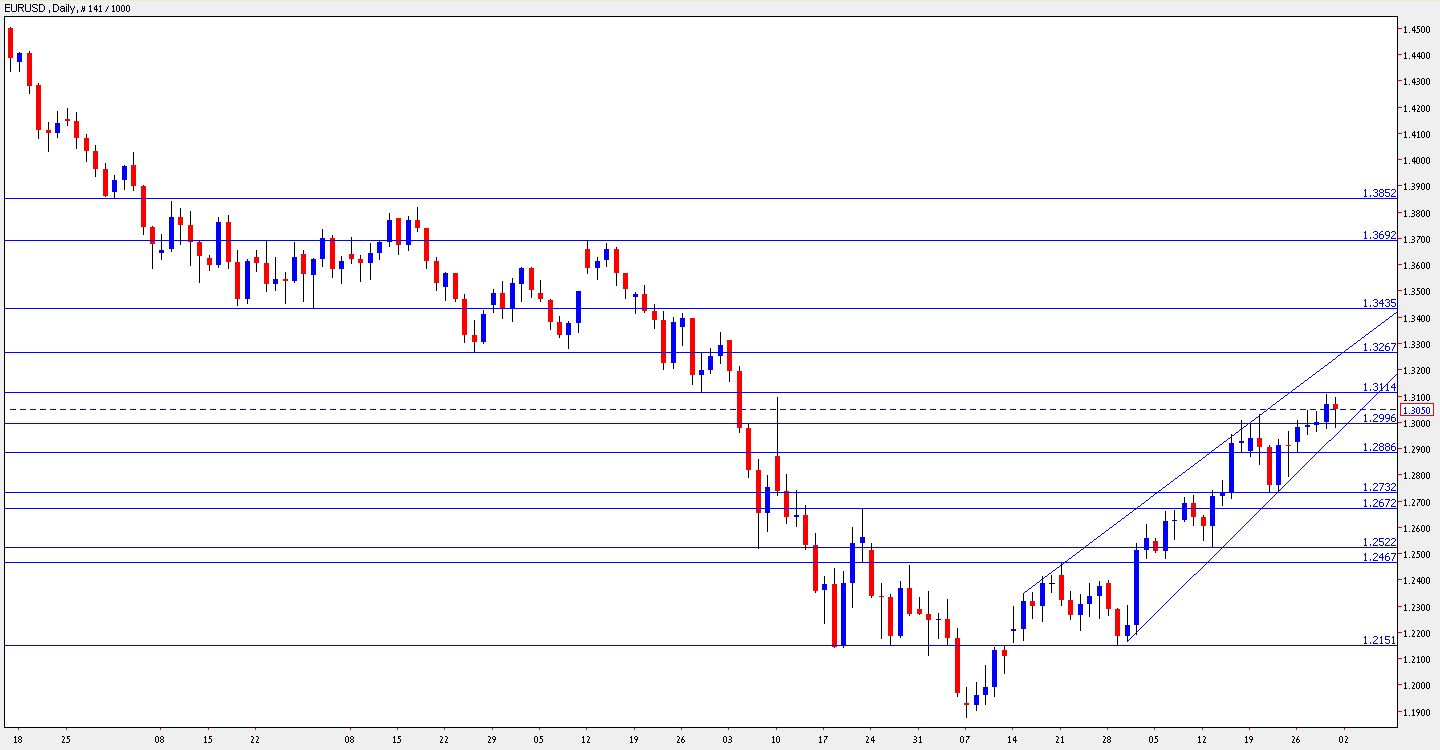
EUR/USD Weekly Technical Forecast (Aug 2-6 2010)

The rate decision stand in the center of a week full with economic indicators. Here’s an outlook for the European events and an updated technical analysis for EUR/USD.

EUR/USD daily chart with support and resistance lines on it. Click to enlarge:

eur usd forecast

The Euro edged up in the past week, but did it with hesitation. It’s still too dependent on US weakness to rise. When more credit rating issues appeared in Spain, it took a breather. Will it make an impressive breakout this week, or will the rally end? Let’s start:

  1. Final Manufacturing PMI: Published on Monday at 8:00 GMT. Purchasing managers in Europe’s manufacturing sector were more optimistic according to the initial release, sending the score from 55.6 to 56.5 points. This will probably be confirmed now.

  2. PPI: Published on Tuesday at 9:00 GMT. Friday’s CPI Flash Estimate saw inflation rising at an annual pace of 1.7% – advancing but falling short of expectations. Also producer prices are expected to be on the rise – from 0.3% to 0.4%. Only a more significant rise will cause inflationary fears.

  3. Final Services PMI: Published on Wednesday at 8:00 GMT. Also the purchasing managers in the services sector became more optimistic – with the score rising from 55.5 to 56. It will probably be confirmed as well.

  4. Retail Sales: Published on Wednesday at 9:00 GMT. Germany’s retail sales were a bitter disappointment on Friday – dropping by 0.9%. The figure for whole Euro-zone is expected to follow with a drop as well, but much more modest – 0.1%. A positive number will boost the Euro.

  5. German Factory Orders: Published on Thursday at 10:00 GMT. After many strong months, factory order corrected with a drop last month, of 0.5%. And now, just before the rate decision, we’re expecting the positive trend to resume with a rise of 1.5%.

  6. Rate decision: Published on Thursday at 11:45 GMT. Jean-Claude Trichet is widely expected to leave the Minimum Bid Rate unchanged at 1%. While inflation is slightly rising, it’s still far from worrying levels (like in Britain). On the other hand, unemployment remains high in the Euro-zone, and the debt crisis is far from over. 45 minutes after the rate decision, Trichet will hold a press conference. Any comments will rock the Euro.

  7. German Industrial Production: Published on Friday at 10:00 GMT. Complementing the factory orders number on the previous day, this figure is also expected to be positive – with a rise here of 1.1%, continuing a positive trend of the past 3 months.


EUR/USD Technical Analysis

The Euro began the week by rising from the 1.2880 line towards 1.30. After struggling with strong resistance around this level, EUR/USD climbed up to 1.3107, just under the 1.3114 resistance level, before dropping and closing at 1.3050.

Most lines haven’t changed since last week’s outlook. EUR/USD is currently bound between the psychological level of 1.30 and the fierce resistance line of 1.3114 – a line that supported the pair in May, before the big collapse, and afterwards capped an attempt of recovery.

If Euro/Dollar breaks above this level, the next hurdle is 1.3267, which was a support line twice (March and April). Above, 1.3435 was also a strong line of support in February and later worked as resistance in April.

Even higher, the notable lines of resistance are at 1.37, and this is followed by the area of 1.3850 – a level last seen 6 months ago.

Looking down below 1.30, the next line is 1.2880, which held the pair in 2009 and now works as a minor line of support. Below, 1.2720 worked as a resistance line at the beginning of July and later supported the pair – it’s a strong support line now. It’s followed by 1.2672, which capped the pair in May.

Lower, 1.2520 worked as a support line several times in the past, and it’s followed by a former resistance line at 1.2460, which provides further support. There are more lines below, with 1.2150 being the most significant one down the road.

It’s also interesting to look at the pair’s uptrend channel (also in the graph. EUR/USD is currently trading within this steep channel. A break to either direction will be a signal.

I am neutral on EUR/USD.

The Euro-zone still has issues of its own. The stress tests failed to provide confidence and the unemployment rate is still very high. On the other hand, the US isn’t doing too good either. 1.3114 is the key level.