Non-Farm Payrolls exceeded expectations and fell by only 54K, nearly half of early expectations. The unemployment rate rose from 9.5% to 9.6% as expected. The initial reaction was a drop of EUR/USD but it immediately rose back up. USD/JPY is going in one direction – up.
The important part of the release was the the private sector figure. Here, a gain of 67,00 was published, also significantly better than 40,000 that was predicted. And there was more good news:
A revision of July’s figure showed that Non-Farm Payrolls fell by only 54K instead of 131K initially reported. Also the private sector’s number was revised in July from 71K to 107K. All the numbers are significantly better than expected.
EUR/USD traded around 1.2840 before the release. It then fell to 1.2810, leaped to 1.2875 and fell back again. It’s currently looking for a direction. We could see a relief rally on EUR/USD and stocks.
The Japanese yen, that has a low yield and is also a “safe haven” currency fell sharply. USD/JPY jumped from 84.40 to 85.20 after the release – no choppy trading – just one direction – up, according to scenario #2 in the Non-Farm Payrolls preview.
As written in the preview, this publication of Non-Farm Payrolls is a test for the fears of a double-dip recession. Did this calm the markets? As always, analysts will debate over this for some time. A recovery in jobs is the key to recovery.
Showing posts with label Forex News. Show all posts
Showing posts with label Forex News. Show all posts
Saturday, September 4, 2010


Non-Farm Payrolls Finally Great – No Double Dip?
Non-Farm Payrolls exceeded expectations and fell by only 54K, nearly half of early expectations. The unemployment rate rose from 9.5% to 9.6% as expected. The initial reaction was a drop of EUR/USD but it immediately rose back up. USD/JPY is going in one direction – up.
The important part of the release was the the private sector figure. Here, a gain of 67,00 was published, also significantly better than 40,000 that was predicted. And there was more good news:
A revision of July’s figure showed that Non-Farm Payrolls fell by only 54K instead of 131K initially reported. Also the private sector’s number was revised in July from 71K to 107K. All the numbers are significantly better than expected.
EUR/USD traded around 1.2840 before the release. It then fell to 1.2810, leaped to 1.2875 and fell back again. It’s currently looking for a direction. We could see a relief rally on EUR/USD and stocks.
The Japanese yen, that has a low yield and is also a “safe haven” currency fell sharply. USD/JPY jumped from 84.40 to 85.20 after the release – no choppy trading – just one direction – up, according to scenario #2 in the Non-Farm Payrolls preview.
As written in the preview, this publication of Non-Farm Payrolls is a test for the fears of a double-dip recession. Did this calm the markets? As always, analysts will debate over this for some time. A recovery in jobs is the key to recovery.
The important part of the release was the the private sector figure. Here, a gain of 67,00 was published, also significantly better than 40,000 that was predicted. And there was more good news:
A revision of July’s figure showed that Non-Farm Payrolls fell by only 54K instead of 131K initially reported. Also the private sector’s number was revised in July from 71K to 107K. All the numbers are significantly better than expected.
EUR/USD traded around 1.2840 before the release. It then fell to 1.2810, leaped to 1.2875 and fell back again. It’s currently looking for a direction. We could see a relief rally on EUR/USD and stocks.
The Japanese yen, that has a low yield and is also a “safe haven” currency fell sharply. USD/JPY jumped from 84.40 to 85.20 after the release – no choppy trading – just one direction – up, according to scenario #2 in the Non-Farm Payrolls preview.
As written in the preview, this publication of Non-Farm Payrolls is a test for the fears of a double-dip recession. Did this calm the markets? As always, analysts will debate over this for some time. A recovery in jobs is the key to recovery.
Sunday, August 29, 2010
Coordinated Intervention To Weaken the Yen?
The Bank of Japan announced an immediate emergency meeting to begin very soon – Monday 00:00 GMT. There are expectations for new easing steps to boost the economy. But there might be more – Will we see a global coordinated intervention to weaken the yen? Yen crosses are already on the rise.
The governor of the BOJ, Masaaki Shirakawa, shortened his visit in Jackson Hole, where he met other central bankers, and returned swiftly to Japan. At 00:00 GMT, or 9:00 Japanese time, the BOJ is meeting for an emergency meeting. It happens as the week begins in Japan, and very early for JPY crosses in other places in the world:
The rather new Japanese government is showing growing vocal concern about the strength of the yen. USD/JPY recently reached fresh 15 year lows. This hurts the Japanese economy, that is based on exports.
The Japanese government, led by Naoto Kan, pushed the BOJ to take measures, and did it in a public manner. It is also expected to declare a new stimulus program of its own, in a meeting on Tuesday.
But the BOJ doesn’t wait for Tuesday. According to expectations, the bank might enlarge its existing lending encouraging plan:
Coordinated Intervention?
But there might be more under the hood. There’s talk that the BOJ will intervene directly in the markets to weaken the yen. As we know from various examples, central bank interventions are short-lived. The Swiss National Bank lost a lot of money on its interventions.
The meeting of many central bankers from all over the world in the Jackson Hole Symposium raises the question of a coordinated effort to weaken the yen. Together with central banks in the US and Europe, a move to weaken the yen might be successful.
Similar coordinated moves in the past had significant success. The US might support this move also as a maneuver against China, which keeps it’s currency, the yuan, weak, angering the US.
In the meantime, the Japanese yen weakens on thin trading. USD/JPY rose to 85.70, GBP/JPY rose above 133, EUR/JPY touched 109.25 and CHF/JPY reached 83.40.
This is a very early hour in the week – only the Sydney session is open at the time of writing. The Tokyo session will open soon. Later, there’s a bank holiday in Britain.
Thin trading is a good timing for an intervention.
The BOJ will hold a press conference at 5:30 GMT, and we’ll get to know what’s going on. An announcement of further easing steps is likely to weaken the yen only marginally. A coordinated intervention will send all JPY crosses to the skies.
The governor of the BOJ, Masaaki Shirakawa, shortened his visit in Jackson Hole, where he met other central bankers, and returned swiftly to Japan. At 00:00 GMT, or 9:00 Japanese time, the BOJ is meeting for an emergency meeting. It happens as the week begins in Japan, and very early for JPY crosses in other places in the world:
The rather new Japanese government is showing growing vocal concern about the strength of the yen. USD/JPY recently reached fresh 15 year lows. This hurts the Japanese economy, that is based on exports.
The Japanese government, led by Naoto Kan, pushed the BOJ to take measures, and did it in a public manner. It is also expected to declare a new stimulus program of its own, in a meeting on Tuesday.
But the BOJ doesn’t wait for Tuesday. According to expectations, the bank might enlarge its existing lending encouraging plan:
The central bank may expand a three-month 0.1 percent loan facility, increasing the supply of funds from 20 trillion yen ($230 billion) or extend the duration of loans to six months, Dow Jones reported.
Coordinated Intervention?
But there might be more under the hood. There’s talk that the BOJ will intervene directly in the markets to weaken the yen. As we know from various examples, central bank interventions are short-lived. The Swiss National Bank lost a lot of money on its interventions.
The meeting of many central bankers from all over the world in the Jackson Hole Symposium raises the question of a coordinated effort to weaken the yen. Together with central banks in the US and Europe, a move to weaken the yen might be successful.
Similar coordinated moves in the past had significant success. The US might support this move also as a maneuver against China, which keeps it’s currency, the yuan, weak, angering the US.
In the meantime, the Japanese yen weakens on thin trading. USD/JPY rose to 85.70, GBP/JPY rose above 133, EUR/JPY touched 109.25 and CHF/JPY reached 83.40.
This is a very early hour in the week – only the Sydney session is open at the time of writing. The Tokyo session will open soon. Later, there’s a bank holiday in Britain.
Thin trading is a good timing for an intervention.
The BOJ will hold a press conference at 5:30 GMT, and we’ll get to know what’s going on. An announcement of further easing steps is likely to weaken the yen only marginally. A coordinated intervention will send all JPY crosses to the skies.
Friday, August 27, 2010
US GDP Sharply Revised Downwards – Trading Remains Tight
The second release of GDP for the second quarter was indeed bad – a downwards revision from 2.4% to 1.6%, slightly better than a revision to 1.5%. The initial reaction was dollar positive, but this was quickly erased.
EUR/USD was down from 1.2720 (almost the resistance line) to 1.27. This drop was very limited and the pair returned upwards. The market is still awaiting Ben Bernanke’s speech in Jackson Hole. He’ll have something to relate to.
GBP/USD dropped to the support line of 1.5470 immediately after the release. AUD/USD rises towards 89 cents. USD/CAD is down just under 1.06. All have recovered in the meantime. Tension is high. As aforementioned, these moves are limited as the result was quite accurately predicted, and Bernanke’s speech at 14:00 GMT is awaited.
Earlier this week, we received another bunch of terrible American figures. The one figure that stood out was existing home sales, that plunged by 27% and shocked the markets, suggesting the US could fall alone.
Also sales of new homes dived more than expected. Durable goods orders rose by only 0.3% (exp. +2.9%) and core durable goods orders, the more important figure, dived by 3.8% A rise was predicted. The only light in the dark tunnel was a small drop in unemployment claims, although last week’s figure was revised higher.
These figures, together with others from previous weeks such as the Non-Farm Payrolls from August 6th, raised the fear of a double-dip recession in the US. Nouriel Roubini, also known as Dr. Doom, said there’s now a 40% chance of double-dip recession, something that is very rare.
With the growth rate quickly deteriorating from over 5% in Q4 2009 to over 3% in Q1 and just over 1% in Q2, a negative growth figure in Q3 cannot be ruled out, especially if employment remains so weak.
EUR/USD was down from 1.2720 (almost the resistance line) to 1.27. This drop was very limited and the pair returned upwards. The market is still awaiting Ben Bernanke’s speech in Jackson Hole. He’ll have something to relate to.
GBP/USD dropped to the support line of 1.5470 immediately after the release. AUD/USD rises towards 89 cents. USD/CAD is down just under 1.06. All have recovered in the meantime. Tension is high. As aforementioned, these moves are limited as the result was quite accurately predicted, and Bernanke’s speech at 14:00 GMT is awaited.
Earlier this week, we received another bunch of terrible American figures. The one figure that stood out was existing home sales, that plunged by 27% and shocked the markets, suggesting the US could fall alone.
Also sales of new homes dived more than expected. Durable goods orders rose by only 0.3% (exp. +2.9%) and core durable goods orders, the more important figure, dived by 3.8% A rise was predicted. The only light in the dark tunnel was a small drop in unemployment claims, although last week’s figure was revised higher.
These figures, together with others from previous weeks such as the Non-Farm Payrolls from August 6th, raised the fear of a double-dip recession in the US. Nouriel Roubini, also known as Dr. Doom, said there’s now a 40% chance of double-dip recession, something that is very rare.
With the growth rate quickly deteriorating from over 5% in Q4 2009 to over 3% in Q1 and just over 1% in Q2, a negative growth figure in Q3 cannot be ruled out, especially if employment remains so weak.
Bernanke Hints Awful US Situation. Lifting Inflation Goals?
Ben Bernanke talks about adding more stimulus steps if necessary, and mentions a surprising option of lifting inflation goals to boost the economy. While he said this step doesn’t have support in the FOMC, the fact that he even mentioned it is a big surprise. This is his subtle way of saying that the situation is dire and that drastic massive dollar printing steps are considered. More trouble in the US means a global slowdown. The fear triggered by his speech sends the dollar higher. EUR/USD fell 50 about pips to 1.2675 and then slightly recovered. Analysis of Bernanke’s speech:
As Bernanke’s words always have some mystery in them, it’ll take time until the market fully digests the meaning of his words. There are more factors to weigh in:
On the other hand, Bernanke did talk about good growth in 2011 and onwards. This is currently dismissed by the markets, but it sure serves as a serious balance to the hint about further stimulus if necessary.
In his speech, he said the central bank still has many tools. In the past he talked about three tools, and he repeated them again now. He also introduced a fourth tool:
Yet again, in order to balance this surprising option of lifting inflation, a surprise indeed, Bernanke immediately said that this isn’t necessary and that there’s no support for such a move in the FOMC.
But he did mention it. What is the meaning of lifting inflation goals? How can the bank lift inflation – with much more quantitative easing – much more dollar printing. Is the situation so bad? Probably not yet, but mentioning this option sure is a surprise.
The last two hours of Friday’s London session are always messy, as many traders hurry to close positions before the weekend.
In addition, the market is still digesting the GDP downgrade that the US received earlier today. The second release for the second quarter showed a downside revision of the GDP from 2.4% to 1.6% (annualized). This was marginally better than expected. At first, the dollar gained against the Euro, but then these gains were erased, as the tension was mounting towards Bernanke’s words.
As Bernanke’s words always have some mystery in them, it’ll take time until the market fully digests the meaning of his words. There are more factors to weigh in:
On the other hand, Bernanke did talk about good growth in 2011 and onwards. This is currently dismissed by the markets, but it sure serves as a serious balance to the hint about further stimulus if necessary.
In his speech, he said the central bank still has many tools. In the past he talked about three tools, and he repeated them again now. He also introduced a fourth tool:
A rather different type of policy option, which has been proposed by a number of economists, would have the Committee increase its medium-term inflation goals above levels consistent with price stability. I see no support for this option on the FOMC. Conceivably, such a step might make sense in a situation in which a prolonged period of deflation had greatly weakened the confidence of the public in the ability of the central bank to achieve price stability, so that drastic measures were required to shift expectations. Also, in such a situation, higher inflation for a time, by compensating for the prior period of deflation, could help return the price level to what was expected by people who signed long-term contracts, such as debt contracts, before the deflation began.
Yet again, in order to balance this surprising option of lifting inflation, a surprise indeed, Bernanke immediately said that this isn’t necessary and that there’s no support for such a move in the FOMC.
But he did mention it. What is the meaning of lifting inflation goals? How can the bank lift inflation – with much more quantitative easing – much more dollar printing. Is the situation so bad? Probably not yet, but mentioning this option sure is a surprise.
The last two hours of Friday’s London session are always messy, as many traders hurry to close positions before the weekend.
In addition, the market is still digesting the GDP downgrade that the US received earlier today. The second release for the second quarter showed a downside revision of the GDP from 2.4% to 1.6% (annualized). This was marginally better than expected. At first, the dollar gained against the Euro, but then these gains were erased, as the tension was mounting towards Bernanke’s words.
Thursday, August 12, 2010
Euro Rising Before a New Fall?
EUR USD has taken serious damage after the Fed decision and bottomed out at a lower support level. Now, the pair is on the rise. After losing the steep uptrend channel, the direction seems down.
The Fed decision on Tuesday evening was digested on Wednesday, and the results were devastating. Fear of a global slowdown, or even a global double-dip recession sent stock markets tumbling down and forex traders flocking into “safe haven” currencies. The yen reached a fresh 15 year high against the dollar, and the dollar in tun made the highest daily gain in a long time. This first big wave is over. What now?
EUR/USD, that collapsed by over 300 pips, found support around the 1.2880 minor support line and managed to climb above 1.29. Further gains are capped by 1.30, the round number, and by 1.3114 that served as a clear line of resistance and later as a line of support.
Further on the road, 1.3267 provides further resistance. It was a support line in April, turned into a resistance line and was only temporarily breached after the disappointing US Non-Farm Payrolls.
But the direction seems down.
Technicals: Looking at the charts, we can see that the steep uptrend that characterized the pair’s trading in the past two months has been violently broken. After steep gains, this breakdown signals a sharp fall. Indeed, a steep downtrend channel is beginning to form.
If 1.2880 is convincingly broken, the next important support line for the pair appears at 1.2720. This is a rather new line. It capped the Euro’s gains during the strong rise for a comparably longer time than other lines.
Below, 1.2670 is the next line of support, followed by 1.2520 and 1.2460 – another strong line that capped the pair. Beyond this horizon there are more lines, with 1.2150 being the most important one.
Fundamentals: The FOMC Statement was a groundbreaking event. For many investors and analysts, it gave an official stamp to the worries about the US plunging into a double dip recession and taking the whole world with it. It has the same magnitude as their decision 17 months beforehand, in March 2009, when massive dollar printing was announced. The latest decision didn’t announce fresh dollar printing, but ignited deep fear.
This fear changed the paradigm once again. In the past two months, we’ve seen ”normal” market behavior – when the US dollar weakened on weak US data. This has changed with the Fed decision – weak US data is expected to create more fear, strengthening the US dollar. Risk aversion is back. Big time.
European fundamentals aren’t too good. The debt crisis isn’t really behind us. The stress tests skipped the big issue of sovereign debt and eventually weren’t taken seriously.
We’ll get an important look at European fundamentals on Friday – GDP will be released, first for Germany. The Euro-zone’s locomotive holds high hopes of strong growth in Q2 – 1.3%. Will it live up to these expectations?
For the rest of the Euro-zone, expectations stand on a nice growth rate of 0.7%. Such growth rates haven’t been seen in a long time. Also here, a disappointment can be destructive.
Later on Friday, we get US retail sales, CPI and finally the consumer sentiment indicator from the University of Michigan. All figures are expected to be modest. Any disappointment will push EUR/USD lower, as the risk aversive trend is very strong.
The Fed decision on Tuesday evening was digested on Wednesday, and the results were devastating. Fear of a global slowdown, or even a global double-dip recession sent stock markets tumbling down and forex traders flocking into “safe haven” currencies. The yen reached a fresh 15 year high against the dollar, and the dollar in tun made the highest daily gain in a long time. This first big wave is over. What now?
EUR/USD, that collapsed by over 300 pips, found support around the 1.2880 minor support line and managed to climb above 1.29. Further gains are capped by 1.30, the round number, and by 1.3114 that served as a clear line of resistance and later as a line of support.
Further on the road, 1.3267 provides further resistance. It was a support line in April, turned into a resistance line and was only temporarily breached after the disappointing US Non-Farm Payrolls.
But the direction seems down.
Technicals: Looking at the charts, we can see that the steep uptrend that characterized the pair’s trading in the past two months has been violently broken. After steep gains, this breakdown signals a sharp fall. Indeed, a steep downtrend channel is beginning to form.
If 1.2880 is convincingly broken, the next important support line for the pair appears at 1.2720. This is a rather new line. It capped the Euro’s gains during the strong rise for a comparably longer time than other lines.
Below, 1.2670 is the next line of support, followed by 1.2520 and 1.2460 – another strong line that capped the pair. Beyond this horizon there are more lines, with 1.2150 being the most important one.
Fundamentals: The FOMC Statement was a groundbreaking event. For many investors and analysts, it gave an official stamp to the worries about the US plunging into a double dip recession and taking the whole world with it. It has the same magnitude as their decision 17 months beforehand, in March 2009, when massive dollar printing was announced. The latest decision didn’t announce fresh dollar printing, but ignited deep fear.
This fear changed the paradigm once again. In the past two months, we’ve seen ”normal” market behavior – when the US dollar weakened on weak US data. This has changed with the Fed decision – weak US data is expected to create more fear, strengthening the US dollar. Risk aversion is back. Big time.
European fundamentals aren’t too good. The debt crisis isn’t really behind us. The stress tests skipped the big issue of sovereign debt and eventually weren’t taken seriously.
We’ll get an important look at European fundamentals on Friday – GDP will be released, first for Germany. The Euro-zone’s locomotive holds high hopes of strong growth in Q2 – 1.3%. Will it live up to these expectations?
For the rest of the Euro-zone, expectations stand on a nice growth rate of 0.7%. Such growth rates haven’t been seen in a long time. Also here, a disappointment can be destructive.
Later on Friday, we get US retail sales, CPI and finally the consumer sentiment indicator from the University of Michigan. All figures are expected to be modest. Any disappointment will push EUR/USD lower, as the risk aversive trend is very strong.
Tuesday, August 10, 2010
Possiblities of Fed Decision
The upcoming FOMC Meeting holds high expectations for easing steps by the Federal Reserve – steps that can help stimulate the economy that has slowed down. Here are possible scenarios for this decision, and possible market reactions.
On Tuesday, August 10th, at 18:15, Ben Bernanke and his team will release the FOMC statement. I’ve already written about how Bernanke can print dollars and weaken the greenback, but as the market already prices in such steps, the impact on the market depends on the details:
Massive Dollar Spilling: The statement consists of a deep concern for a double dip recession and declares a program to buy assets in hundreds of billions of dollars. This is the worst case scenario. Showing worries might send traders away from the dollar. Spilling hundreds of billions of dollars in a new Quantitative Easing program means similar impact as in March 2009 – the dollar lost 600 pips against the Euro. Bernanke wouldn’t want to create panic. Probability: Low.
Renewal of asset buying: The statement shows concern about the slowdown and states that the current asset buying program that was stopped in March 2010 will be temporarily resumed at a moderate scale. Taking careful measures and carefully wording the statements is what the Fed does best. This scenario is bad for the dollar, but as the market already expects this, the dollar will slide down moderately. Probability: High
Change of wording: The statement shows concern about the slowdown, and vows to act if necessary, without any measures taken. Changing the wording of the statement without taking any steps is something that Bernanke mentioned in a recent public appearance. The market is expecting real steps to be taken, especially after the Non-Farm Payrolls, and while option won’t come as a huge surprise, not spilling dollars will boost the dollar, and erase some of the Euro’s recent gains. Probability: Medium.
No change in the statement: This means that the only dovish part in the statement is the pledge to keep interest rates low for “an extended period of time”. This “wait and see” policy, that happened so many times in the past will be a big surprise now, and will turn the recent gains of EUR USD to a case of “Buy by the rumor, sell by the fact”. The dollar will significantly rise. Probability: Low.
The chance of an optimistic statement about the economy is highly unlikely, and needless to say, the chance of a rate hike is zero. Inflation is no threat – the Federal Funds Rate will stay at a maximum rate of 0.25%.
What do think will happen?
On Tuesday, August 10th, at 18:15, Ben Bernanke and his team will release the FOMC statement. I’ve already written about how Bernanke can print dollars and weaken the greenback, but as the market already prices in such steps, the impact on the market depends on the details:
Massive Dollar Spilling: The statement consists of a deep concern for a double dip recession and declares a program to buy assets in hundreds of billions of dollars. This is the worst case scenario. Showing worries might send traders away from the dollar. Spilling hundreds of billions of dollars in a new Quantitative Easing program means similar impact as in March 2009 – the dollar lost 600 pips against the Euro. Bernanke wouldn’t want to create panic. Probability: Low.
Renewal of asset buying: The statement shows concern about the slowdown and states that the current asset buying program that was stopped in March 2010 will be temporarily resumed at a moderate scale. Taking careful measures and carefully wording the statements is what the Fed does best. This scenario is bad for the dollar, but as the market already expects this, the dollar will slide down moderately. Probability: High
Change of wording: The statement shows concern about the slowdown, and vows to act if necessary, without any measures taken. Changing the wording of the statement without taking any steps is something that Bernanke mentioned in a recent public appearance. The market is expecting real steps to be taken, especially after the Non-Farm Payrolls, and while option won’t come as a huge surprise, not spilling dollars will boost the dollar, and erase some of the Euro’s recent gains. Probability: Medium.
No change in the statement: This means that the only dovish part in the statement is the pledge to keep interest rates low for “an extended period of time”. This “wait and see” policy, that happened so many times in the past will be a big surprise now, and will turn the recent gains of EUR USD to a case of “Buy by the rumor, sell by the fact”. The dollar will significantly rise. Probability: Low.
The chance of an optimistic statement about the economy is highly unlikely, and needless to say, the chance of a rate hike is zero. Inflation is no threat – the Federal Funds Rate will stay at a maximum rate of 0.25%.
What do think will happen?
Saturday, August 7, 2010
EUR/USD Rises on NFP, But Gains Could Be Capped
US Non-Farm Payrolls dropped by 131K, double the median expectations. This result is very disappointing. EUR/USD leaped from 1.3170 before the release to 1.3220 immediately afterwards. Note that the private sector, which is in the limelight added 71,000 jobs, so the Euro might not have the strength needed to break higher.
The unemployment rate remained unchanged at 9.5%, slightly better than a rise to 9.6% that was expected. But this isn’t important:
What is important is that the private sector gained jobs – 71,000. This is a better report than the ADP number (48K), although slightly worse than expected (90K) and it could ease the fall of the dollar, despite the terrible headline figure. So, 1.3267 – the peak at the beginning of the week which is also an important resistance line, could hold.
Update: EUR/USD made the break higher but stayed close to the resistance line – 1.3267.
Earlier this week, the ADP Non-Farm Payrolls report was slightly better than expected. It showed a gain of 48,000 jobs in the private sector. This created hope for a better result in the official Non-Farm Payrolls, especially as the government’s census in May still has an impact on the headline number. As written in the NFP preview, the private sector part of the NFP was in the limelight, making also the ADP report more important.
The US dollar lost ground up to Wednesday’s ADP report, the dollar lost ground, and then it stabilized. On the other hand, Thursday’s weekly jobless claims report was disappointing – it rose to 479K, just below the top border of a range that characterizes this figure in recent months. But this didn’t have too much impact on the greenback – tension remained high and trading became quite tight before the release.
EUR/USD got close to the bottom border of the uptrend channel, but managed to stay away before the release, and even escape it as the New York session opened at 12:00 GMT. As aforementioned, it later jumped.
EUR/USD Technicals
A break above 1.3267 will open the road to 1.3392, the uptrend resistance (currently at this zone), and then to the important 1.3435 line, which was a support line in the past.
A drop will send the pair to support around 1.3160, which is the uptrend support line at the moment and further below to 1.3114 – which turned from a strong line of resistance to a strong line of support this week.
Other Currencies
The Canadian dollar suffered from losses against the greenback, due to its own employment data. Canada lost jobs in July – this disappointing outcome sent USD/CAD above 1.02.
Other currencies remained around earlier levels before the release, and reacted in a similar way to the Euro afterwards.
The unemployment rate remained unchanged at 9.5%, slightly better than a rise to 9.6% that was expected. But this isn’t important:
What is important is that the private sector gained jobs – 71,000. This is a better report than the ADP number (48K), although slightly worse than expected (90K) and it could ease the fall of the dollar, despite the terrible headline figure. So, 1.3267 – the peak at the beginning of the week which is also an important resistance line, could hold.
Update: EUR/USD made the break higher but stayed close to the resistance line – 1.3267.
Earlier this week, the ADP Non-Farm Payrolls report was slightly better than expected. It showed a gain of 48,000 jobs in the private sector. This created hope for a better result in the official Non-Farm Payrolls, especially as the government’s census in May still has an impact on the headline number. As written in the NFP preview, the private sector part of the NFP was in the limelight, making also the ADP report more important.
The US dollar lost ground up to Wednesday’s ADP report, the dollar lost ground, and then it stabilized. On the other hand, Thursday’s weekly jobless claims report was disappointing – it rose to 479K, just below the top border of a range that characterizes this figure in recent months. But this didn’t have too much impact on the greenback – tension remained high and trading became quite tight before the release.
EUR/USD got close to the bottom border of the uptrend channel, but managed to stay away before the release, and even escape it as the New York session opened at 12:00 GMT. As aforementioned, it later jumped.
EUR/USD Technicals
A break above 1.3267 will open the road to 1.3392, the uptrend resistance (currently at this zone), and then to the important 1.3435 line, which was a support line in the past.
A drop will send the pair to support around 1.3160, which is the uptrend support line at the moment and further below to 1.3114 – which turned from a strong line of resistance to a strong line of support this week.
Other Currencies
The Canadian dollar suffered from losses against the greenback, due to its own employment data. Canada lost jobs in July – this disappointing outcome sent USD/CAD above 1.02.
Other currencies remained around earlier levels before the release, and reacted in a similar way to the Euro afterwards.
Sunday, August 1, 2010
Time to Buy Dollars as Euro Reaches Austerity Limits
Aug. 2 (Bloomberg) -- FX Concepts LLC, the hedge fund that bought the euro in June just as it began a 9.7 percent surge against the dollar, now says it’s almost time to get out of the currency.
The firm, which manages $8 billion in assets, expects the euro’s advance from a four-year low on June 7 to come undone by September, partly because European austerity programs will start to weigh on growth. Reports last week that showed Spanish consumer confidence falling to the lowest level this year and banks tightening credit standards in the region suggest the budget measures may already be undermining the recovery.
The same fiscal measures that helped restore confidence in the euro may soon weaken the region’s economies and torpedo the rally. A July 30 survey of 21 money managers overseeing $1.29 trillion by Jersey City, New Jersey-based research firm Ried Thunberg ICAP Inc. found 75 percent don’t expect Europe’s common currency to strengthen over the next three months.
“Austerity is really bad for growth,” said Jonathan Clark, vice chairman at New York-based FX Concepts, the world’s biggest currency hedge fund. “In the U.S., austerity is mainly on the state level, but in Europe they are whole-hog into cutting spending to reduce deficits. Under a pessimistic scenario, the European currencies are in a lot of trouble.”
Spending Cuts
Spain, Portugal and Greece will reduce spending by an average 4.3 percent of gross domestic product from 2009 to 2011, said Gilles Moec, an economist in London at Deutsche Bank AG, Germany’s largest lender. The euro area will expand 1.5 percent this year, less than a previous estimate of 2 percent, UBS AG, the biggest Swiss bank by assets, said in a July 16 report.
The cuts contrast with the U.S., where President Barack Obama signed into law a $34 billion extension of unemployment benefits last month. The Congressional Budget Office projects a record $1.47 trillion deficit this fiscal year ending Sept. 30, and $1.42 trillion in 2011.
While U.S. growth is slowing, it beats the European Union, where a 750 billion-euro ($981 billion) backstop for the region’s most indebted nations stabilized the currency after it slid from $1.5144 on Nov. 25 to the June 7 low.
U.S. GDP grew at a 2.4 percent pace in the second quarter, compared with 3.7 percent in the prior period, the Commerce Department in Washington said July 30. Corporate spending on equipment and software jumped at a 22 percent annual rate, the biggest increase since 1997.
The median second-quarter estimate for the euro region is 1.30 percent, and 1.10 percent for the year, based on a survey of 20 economists by Bloomberg.
Budgetary ‘Zeal’
Federal Reserve Chairman Ben S. Bernanke said July 22 more fiscal stimulus is needed to support the U.S. recovery. European Central Bank President Jean-Claude Trichet is taking the opposite tack, writing in the Financial Times that industrial countries should begin addressing deficits now. The ECB meets Aug. 5, and will likely keep its key interest rate at 1 percent, according to all 51 economists surveyed by Bloomberg.
“We continue to question the sustainability of the euro’s recent rebound given the zeal with which European officials have embraced fiscal consolidation,” said Mansoor Mohi-uddin, global head of currency strategy in Singapore at UBS. The world’s second-biggest currency trader, after Deutsche Bank, predicts the euro will end this year at $1.15. “We expect the euro to face renewed downward pressure.”
Raising Estimates
The euro strengthened 1.1 percent to $1.3052 last week, capping the biggest monthly gain since May 2009. While it rallied against the greenback in the five trading days ended July 30, it was little changed based on Bloomberg Correlation- Weighted Currency Indexes, rising 0.1 percent. It gained 0.2 percent to $1.3080 today.
Rising confidence in Europe’s economy and a slowdown in the U.S. helped quell speculation the 16-nation currency union would splinter. Goldman Sachs Group Inc., Wells Fargo & Co. and at least 12 other firms raised their estimates for the euro in June or July, Bloomberg data show. The 15 percent slide in the first half also proved a boon for German exports.
The number of unemployed Germans fell in July to the lowest level since November 2008, the Federal Labor Agency in Nuremberg said July 29. The same day, an index of executive and consumer confidence in the region compiled by the European Commission in Brussels rose to the highest level since March 2008 in July.
‘Great Deal’
“Governments have done a great deal bringing stability back to the region, and that will manifest itself in a stronger euro in the longer term,” said Fabrizio Fiorini, head of fixed income at Aletti Gestielle SGR SpA in Milan.
The bears say Germany will be unable to prop up the euro much longer as the Frankfurt-based ECB’s quarterly Bank Lending Survey released July 28 showed banks tightening credit. Consumer confidence in Spain fell to minus 26 last month from minus 25 in June, while sentiment in Portugal and France matched their lows for the year, the commission said July 29.
The euro may reach $1.33 before falling along with stocks, according to Clark at FX Concepts. The median estimate of 39 strategists surveyed by Bloomberg is for it to weaken to $1.21 by year-end.
The euro “will correlate strongly with equities,” Clark said. “We are expecting equities to turn around and go down into the second quarter of next year or longer.”
The MSCI World Index advanced 8.9 percent since the euro rally began eight weeks ago.
Bond Signals
Record gains this year by longer-maturity German bonds show investors are concerned growth across Europe may wane. Securities due in 2020 and later returned 13.8 percent, the most since the euro’s introduction in 1999 and compared with 13.1 percent for similar-dated Treasuries, indexes compiled by Bloomberg and the European Federation of Financial Analysts Societies show.
“There’s still a lot of stress in the euro-zone economy,” said Shahid Ikram, deputy chief investment officer at Aviva Investors. The market is “probably viewing the debt burden as being deflationary. Any reduction in debt is likely to impinge on the potential rate of growth,” he said.
The fund management division of Britain’s second-largest insurer, which oversees $403 billion in assets, is looking for opportunities to bet the euro will weaken against the dollar, Ikram said.
Currency Options
Demand for options granting investors the right to sell the euro versus those giving the right to buy suggests eight weeks of appreciation may peter out.
The euro’s three-month option risk-reversal rate was minus 2.14 percent on July 26, approaching the most since June 29. When negative, the measure means demand for options giving the right to sell the currency is greater than demand for those that allow purchases. The rate was minus 1.71 percent today.
“The fiscal challenges facing the euro zone remain immense,” said Shaun Osborne, chief currency strategist at TD Securities Inc. in Toronto and the most accurate foreign- exchange forecaster from the end of 2008 through the first half of this year based on data compiled by Bloomberg. Osborne forecasts the currency will depreciate to $1.08 by year-end.
“The euro needs to go lower to try and help some of the fiscal bite that is going to start to have an impact on some of the more peripheral economies,” he said.
A weaker euro may help companies in the region as it boosts competitiveness and makes revenue earned overseas worth more when it’s brought home. Eni SpA, Italy’s largest oil and gas company, said July 28 second-quarter profit jumped 81 percent as crude prices climbed and the euro declined.
Gary Shilling, president of the economic research firm A. Gary Shilling & Co. in Springfield, New Jersey, has predicted the euro may drop to parity with the dollar since January. He was correct in all 13 of his investment guidelines for 2008.
“This has really just been a lull between storms in Europe,” Shilling said. “We still have a situation where the likelihood of defaults and restructuring in Greece, and probably Portugal and Spain, are still very high. That doesn’t mean they won’t be bailed out, but the turmoil that is likely to result should drive the euro lower.”
The firm, which manages $8 billion in assets, expects the euro’s advance from a four-year low on June 7 to come undone by September, partly because European austerity programs will start to weigh on growth. Reports last week that showed Spanish consumer confidence falling to the lowest level this year and banks tightening credit standards in the region suggest the budget measures may already be undermining the recovery.
The same fiscal measures that helped restore confidence in the euro may soon weaken the region’s economies and torpedo the rally. A July 30 survey of 21 money managers overseeing $1.29 trillion by Jersey City, New Jersey-based research firm Ried Thunberg ICAP Inc. found 75 percent don’t expect Europe’s common currency to strengthen over the next three months.
“Austerity is really bad for growth,” said Jonathan Clark, vice chairman at New York-based FX Concepts, the world’s biggest currency hedge fund. “In the U.S., austerity is mainly on the state level, but in Europe they are whole-hog into cutting spending to reduce deficits. Under a pessimistic scenario, the European currencies are in a lot of trouble.”
Spending Cuts
Spain, Portugal and Greece will reduce spending by an average 4.3 percent of gross domestic product from 2009 to 2011, said Gilles Moec, an economist in London at Deutsche Bank AG, Germany’s largest lender. The euro area will expand 1.5 percent this year, less than a previous estimate of 2 percent, UBS AG, the biggest Swiss bank by assets, said in a July 16 report.
The cuts contrast with the U.S., where President Barack Obama signed into law a $34 billion extension of unemployment benefits last month. The Congressional Budget Office projects a record $1.47 trillion deficit this fiscal year ending Sept. 30, and $1.42 trillion in 2011.
While U.S. growth is slowing, it beats the European Union, where a 750 billion-euro ($981 billion) backstop for the region’s most indebted nations stabilized the currency after it slid from $1.5144 on Nov. 25 to the June 7 low.
U.S. GDP grew at a 2.4 percent pace in the second quarter, compared with 3.7 percent in the prior period, the Commerce Department in Washington said July 30. Corporate spending on equipment and software jumped at a 22 percent annual rate, the biggest increase since 1997.
The median second-quarter estimate for the euro region is 1.30 percent, and 1.10 percent for the year, based on a survey of 20 economists by Bloomberg.
Budgetary ‘Zeal’
Federal Reserve Chairman Ben S. Bernanke said July 22 more fiscal stimulus is needed to support the U.S. recovery. European Central Bank President Jean-Claude Trichet is taking the opposite tack, writing in the Financial Times that industrial countries should begin addressing deficits now. The ECB meets Aug. 5, and will likely keep its key interest rate at 1 percent, according to all 51 economists surveyed by Bloomberg.
“We continue to question the sustainability of the euro’s recent rebound given the zeal with which European officials have embraced fiscal consolidation,” said Mansoor Mohi-uddin, global head of currency strategy in Singapore at UBS. The world’s second-biggest currency trader, after Deutsche Bank, predicts the euro will end this year at $1.15. “We expect the euro to face renewed downward pressure.”
Raising Estimates
The euro strengthened 1.1 percent to $1.3052 last week, capping the biggest monthly gain since May 2009. While it rallied against the greenback in the five trading days ended July 30, it was little changed based on Bloomberg Correlation- Weighted Currency Indexes, rising 0.1 percent. It gained 0.2 percent to $1.3080 today.
Rising confidence in Europe’s economy and a slowdown in the U.S. helped quell speculation the 16-nation currency union would splinter. Goldman Sachs Group Inc., Wells Fargo & Co. and at least 12 other firms raised their estimates for the euro in June or July, Bloomberg data show. The 15 percent slide in the first half also proved a boon for German exports.
The number of unemployed Germans fell in July to the lowest level since November 2008, the Federal Labor Agency in Nuremberg said July 29. The same day, an index of executive and consumer confidence in the region compiled by the European Commission in Brussels rose to the highest level since March 2008 in July.
‘Great Deal’
“Governments have done a great deal bringing stability back to the region, and that will manifest itself in a stronger euro in the longer term,” said Fabrizio Fiorini, head of fixed income at Aletti Gestielle SGR SpA in Milan.
The bears say Germany will be unable to prop up the euro much longer as the Frankfurt-based ECB’s quarterly Bank Lending Survey released July 28 showed banks tightening credit. Consumer confidence in Spain fell to minus 26 last month from minus 25 in June, while sentiment in Portugal and France matched their lows for the year, the commission said July 29.
The euro may reach $1.33 before falling along with stocks, according to Clark at FX Concepts. The median estimate of 39 strategists surveyed by Bloomberg is for it to weaken to $1.21 by year-end.
The euro “will correlate strongly with equities,” Clark said. “We are expecting equities to turn around and go down into the second quarter of next year or longer.”
The MSCI World Index advanced 8.9 percent since the euro rally began eight weeks ago.
Bond Signals
Record gains this year by longer-maturity German bonds show investors are concerned growth across Europe may wane. Securities due in 2020 and later returned 13.8 percent, the most since the euro’s introduction in 1999 and compared with 13.1 percent for similar-dated Treasuries, indexes compiled by Bloomberg and the European Federation of Financial Analysts Societies show.
“There’s still a lot of stress in the euro-zone economy,” said Shahid Ikram, deputy chief investment officer at Aviva Investors. The market is “probably viewing the debt burden as being deflationary. Any reduction in debt is likely to impinge on the potential rate of growth,” he said.
The fund management division of Britain’s second-largest insurer, which oversees $403 billion in assets, is looking for opportunities to bet the euro will weaken against the dollar, Ikram said.
Currency Options
Demand for options granting investors the right to sell the euro versus those giving the right to buy suggests eight weeks of appreciation may peter out.
The euro’s three-month option risk-reversal rate was minus 2.14 percent on July 26, approaching the most since June 29. When negative, the measure means demand for options giving the right to sell the currency is greater than demand for those that allow purchases. The rate was minus 1.71 percent today.
“The fiscal challenges facing the euro zone remain immense,” said Shaun Osborne, chief currency strategist at TD Securities Inc. in Toronto and the most accurate foreign- exchange forecaster from the end of 2008 through the first half of this year based on data compiled by Bloomberg. Osborne forecasts the currency will depreciate to $1.08 by year-end.
“The euro needs to go lower to try and help some of the fiscal bite that is going to start to have an impact on some of the more peripheral economies,” he said.
A weaker euro may help companies in the region as it boosts competitiveness and makes revenue earned overseas worth more when it’s brought home. Eni SpA, Italy’s largest oil and gas company, said July 28 second-quarter profit jumped 81 percent as crude prices climbed and the euro declined.
Gary Shilling, president of the economic research firm A. Gary Shilling & Co. in Springfield, New Jersey, has predicted the euro may drop to parity with the dollar since January. He was correct in all 13 of his investment guidelines for 2008.
“This has really just been a lull between storms in Europe,” Shilling said. “We still have a situation where the likelihood of defaults and restructuring in Greece, and probably Portugal and Spain, are still very high. That doesn’t mean they won’t be bailed out, but the turmoil that is likely to result should drive the euro lower.”
Friday, July 30, 2010
European trouble sends EUR/USD down
EUR/USD is under 1.30 once again, after bouncing at the resistance line, suffering from weak economic data, and with Spain causing worries once again. It now approaches the lower border of the steep uptrend channel. Here’s an update.
I’ve discussed the EUR/USD uptrend channel in the article on Tuesday about Euro/Dollar at resistance. I wrote there that an upwards move could be seen on Thursday, when the only figure released comes from Germany – the locomotive of the Euro-zone. This indeed happened:

German unemployment change surprised with a drop of 20,000 people, slightly better than expected. EUR/USD went higher and peaked at 1.3107, extremely close to the 1.3114 line. This important line held the Euro before it collapsed in May, and also capped the pair when it attempted resistance.
Moody’s: Spain could lose AAA rating
After trading in the vicinity of 1.31 and failing to break, this morning’s bad figures sent the pair down. A disappointment came from Germany – retail sales fell by 0.9%, when an unchanged number was expected. The result was blamed on last month’s strong growth, but it doesn’t really matter – the strongest country in the Euro-zone isn’t perfect.
Then came the figures for the whole Euro-zone: inflation, as reflected in the CPI Flash Estimate rose by an annual rate of 1.7%, short of 1.8% that was predicted – Trichet won’t be in a hurry to raise the rates next week. The second figure didn’t surprise anybody, but is still bad – the unemployment rate in the Euro-zone stands on 10% – still very high.
The really bad news came from Moody’s – the famous credit rating agency warned that Spain may lose its AAA rating. Spain is the fourth largest economy in the Euro-zone.
In mid June, there was fear that Spain would suffer a credit freeze that would hurt the whole Euro-zone. After 6 weeks of successful bond auctions, a world cup victory and quiet on the economic front, Spain hurts the Euro once again. The result – Euro falls.
EUR/USD Falls and Approaches Uptrend Support
EUR/USD fell below the psychological level of 1.30 and currently trades at 1.2983 – over 100 pips drop. The next support line is at 1.2880, which was a support line about a year ago. Further support lines can be seen in the Euro dollar forecast.
But let’s look at the uptrend channel. EUR/USD is now approaching the bottom line of this channel – the uptrend support. The current level of this uptrend is 1.2966, quite close to the current price.
The pair is supported by this line, and the fall stopped at the moment. Nevertheless, this uptrend support is getting closer, and the pair will need to rise quickly in order to escape it and remain in the uptrend channel.
The Euro’s recent ride came on the back of US weakness. We’ll probably see more weakness in the upcoming release of the US Advance GDP for Q2. Still, we got reminder about the situation in Europe – and it isn’t far better.
I’ve discussed the EUR/USD uptrend channel in the article on Tuesday about Euro/Dollar at resistance. I wrote there that an upwards move could be seen on Thursday, when the only figure released comes from Germany – the locomotive of the Euro-zone. This indeed happened:
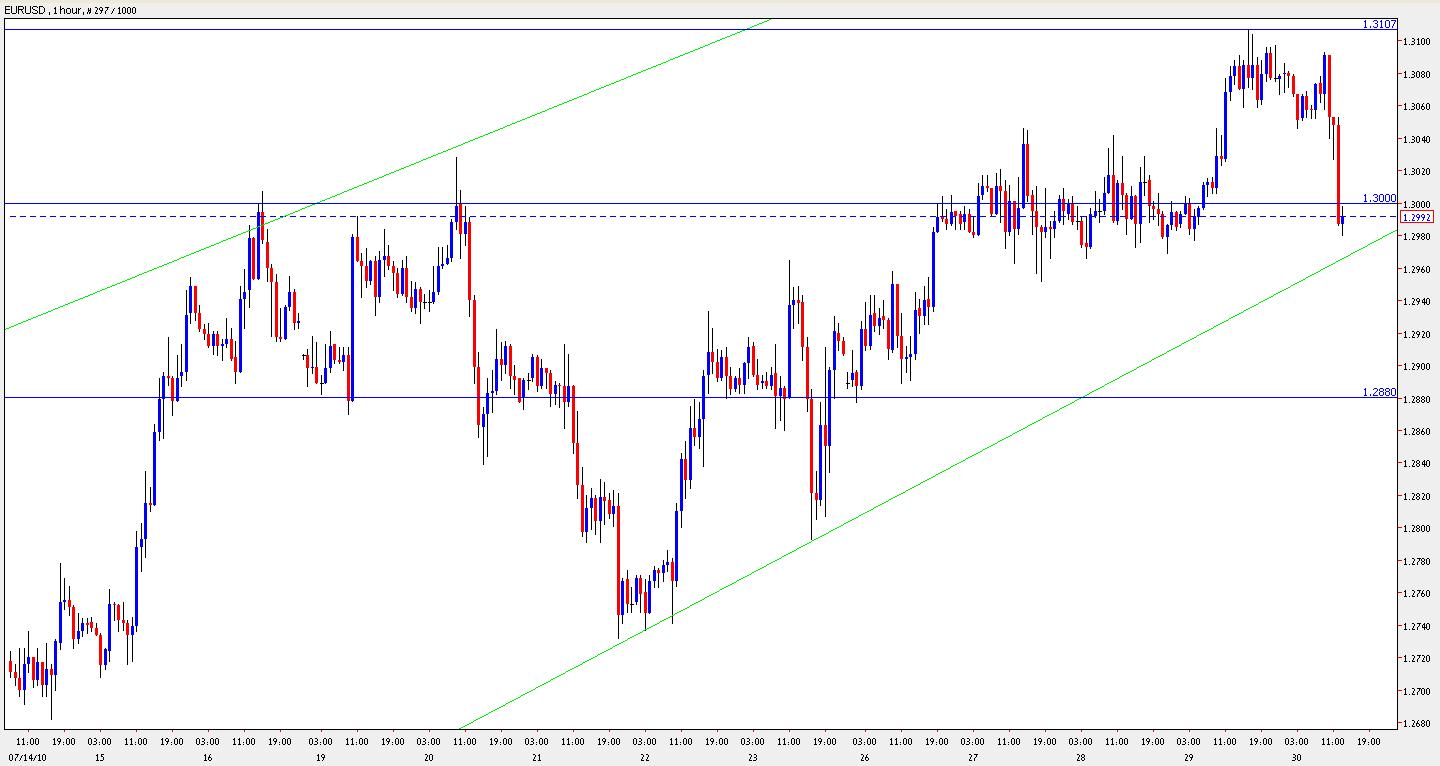
German unemployment change surprised with a drop of 20,000 people, slightly better than expected. EUR/USD went higher and peaked at 1.3107, extremely close to the 1.3114 line. This important line held the Euro before it collapsed in May, and also capped the pair when it attempted resistance.
Moody’s: Spain could lose AAA rating
After trading in the vicinity of 1.31 and failing to break, this morning’s bad figures sent the pair down. A disappointment came from Germany – retail sales fell by 0.9%, when an unchanged number was expected. The result was blamed on last month’s strong growth, but it doesn’t really matter – the strongest country in the Euro-zone isn’t perfect.
Then came the figures for the whole Euro-zone: inflation, as reflected in the CPI Flash Estimate rose by an annual rate of 1.7%, short of 1.8% that was predicted – Trichet won’t be in a hurry to raise the rates next week. The second figure didn’t surprise anybody, but is still bad – the unemployment rate in the Euro-zone stands on 10% – still very high.
The really bad news came from Moody’s – the famous credit rating agency warned that Spain may lose its AAA rating. Spain is the fourth largest economy in the Euro-zone.
In mid June, there was fear that Spain would suffer a credit freeze that would hurt the whole Euro-zone. After 6 weeks of successful bond auctions, a world cup victory and quiet on the economic front, Spain hurts the Euro once again. The result – Euro falls.
EUR/USD Falls and Approaches Uptrend Support
EUR/USD fell below the psychological level of 1.30 and currently trades at 1.2983 – over 100 pips drop. The next support line is at 1.2880, which was a support line about a year ago. Further support lines can be seen in the Euro dollar forecast.
But let’s look at the uptrend channel. EUR/USD is now approaching the bottom line of this channel – the uptrend support. The current level of this uptrend is 1.2966, quite close to the current price.
The pair is supported by this line, and the fall stopped at the moment. Nevertheless, this uptrend support is getting closer, and the pair will need to rise quickly in order to escape it and remain in the uptrend channel.
The Euro’s recent ride came on the back of US weakness. We’ll probably see more weakness in the upcoming release of the US Advance GDP for Q2. Still, we got reminder about the situation in Europe – and it isn’t far better.
Wednesday, July 28, 2010
Mervyn King Orders Pound Higher.
Mervyn King finally changed his tone about inflation, and sent the British Pound above a critical resistance line. Update on the rising sterling.
Mervyn King and inflation – Background
Mervyn King, governor of the Bank of England, dismissed the rising inflation in Britain for a long time. British inflation passed the government’s target range of 1-3% a long time ago. But King still saw the darker sides of the economy. Even when he was forced to write an inflation letter to the Chancellor of the Exchequer (Alistair Darling at that time), he blamed the rising prices on high oil prices, and played a big role in holding the pair down.
But now the tables have turned. Just this Friday, the initial release for British GDP showed a growth rate of 1.1% in Q2, almost double the early expectations. Together with the improvement in employment, there are already lots of good signs for the British economy.
Things are changing also inside the bank. In the past two meetings of the MPC, one member, Andrew Sentance, voted for raising the rates. He was the sole member to think so, but he’s backed by the new Prime Minister, David Cameron.
And now, also Mervyn King acknowledges the rising inflation, and warned about it in an official appearance. In the same appearance, he also hinted that the interest rate wouldn’t rise soon back to “normal” levels. But while it won’t rise to “normal” levels, it could still rise.
GBP/USD Jumps
The Pound faced a strong hurdle at 1.5520. This line was the highest point in February, and proved to be a strong line, succeeding in stopping the Pound time after time.
But now this line was broken – GBP/USD currently trades at 1.5630, jumping above this level and leaving dust behind it. The next level to watch is 1.5720, which was a support line in 2009, when the pair traded at a high range for a very long time.
But a more significant line stands higher – 1.5833 – this was the support line that held GBP/USD before it collapsed to lower levels, and also worked as a resistance line when the pair made an attempt to recover. If this line is broken, the road is open to the round number of 1.60, and the resistance line at 1.6070.
If the pair reverses its moves, immediate support is found at 1.5470, a line that was a resistance line not long ago, and 1.5350 – a pivotal line many times in the past.
Mervyn King and inflation – Background
Mervyn King, governor of the Bank of England, dismissed the rising inflation in Britain for a long time. British inflation passed the government’s target range of 1-3% a long time ago. But King still saw the darker sides of the economy. Even when he was forced to write an inflation letter to the Chancellor of the Exchequer (Alistair Darling at that time), he blamed the rising prices on high oil prices, and played a big role in holding the pair down.
But now the tables have turned. Just this Friday, the initial release for British GDP showed a growth rate of 1.1% in Q2, almost double the early expectations. Together with the improvement in employment, there are already lots of good signs for the British economy.
Things are changing also inside the bank. In the past two meetings of the MPC, one member, Andrew Sentance, voted for raising the rates. He was the sole member to think so, but he’s backed by the new Prime Minister, David Cameron.
And now, also Mervyn King acknowledges the rising inflation, and warned about it in an official appearance. In the same appearance, he also hinted that the interest rate wouldn’t rise soon back to “normal” levels. But while it won’t rise to “normal” levels, it could still rise.
GBP/USD Jumps
The Pound faced a strong hurdle at 1.5520. This line was the highest point in February, and proved to be a strong line, succeeding in stopping the Pound time after time.
But now this line was broken – GBP/USD currently trades at 1.5630, jumping above this level and leaving dust behind it. The next level to watch is 1.5720, which was a support line in 2009, when the pair traded at a high range for a very long time.
But a more significant line stands higher – 1.5833 – this was the support line that held GBP/USD before it collapsed to lower levels, and also worked as a resistance line when the pair made an attempt to recover. If this line is broken, the road is open to the round number of 1.60, and the resistance line at 1.6070.
If the pair reverses its moves, immediate support is found at 1.5470, a line that was a resistance line not long ago, and 1.5350 – a pivotal line many times in the past.
EUR/USD is Flirting with the 1.30 Level.
EUR/USD is flirting with the 1.30 line and currently fails to make the breakout that many people are waiting for – resistance is very strong. In the narrowing uptrend channel, it will soon have to make a decision.

EUR/USD already crossed the psychological level of 1.30 on July 16th, peaking at 1.3007. 4 days later, it also crossed this line, reaching a higher peak – 1.3027. It also traded above the line yesterday and today, with the recent peak being 1.3046. But it doesn’t really make the strong breakout that many people are expecting.
In the graph above (you can click to enlarge), you can see the narrowing uptrend channel on a daily graph. While the Euro can continue rising inside the channel, its steepness will probably not hold the pair for a long time – it will have to choose a direction – breaking above the channel and running faster, or sliding sideways and eventually falling out of it.
Regarding support and resistance lines, 1.3114 is a strong resistance line, followed by 1.3267 and 1.3435. Below, 1.2880 and 1.2670 are important lines. More lines can be seen in the EUR/USD forecast.
EUR/USD Fundamentals
More US weakness has sent the pair higher. The latest sign was the CB Consumer Confidence, that fell sharply to 50.4 points. Today’s durable goods orders from the US could supply more fuel. But this isn’t enough. The Euro needs its own good figures to rise.
Tomorrow, Thursday, the Euro will get a figure that usually exceeds expectations – the German unemployment change. Germany is doing far better than the other countries in the Euro-zone. If the figure will be good once again, the Euro could ride on it. There are no other significant European figures that day.
But if it doesn’t make it, Friday brings a related figure, but for the whole region – the European unemployment rate. At 10%, no good news are expected. There are other figures on Friday, but this is the most important one. So, Thursday has a better chance of seeing an upside breakout in EUR/USD.
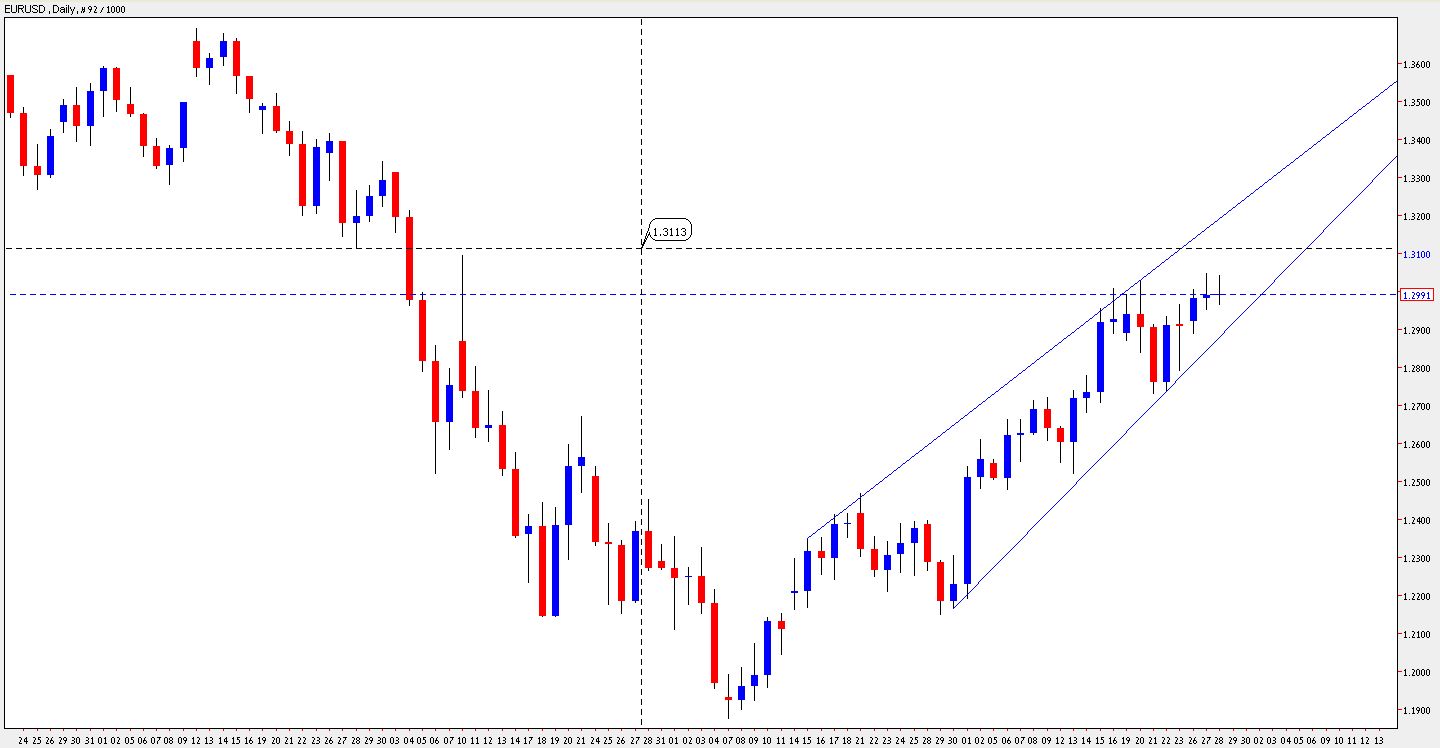
EUR/USD already crossed the psychological level of 1.30 on July 16th, peaking at 1.3007. 4 days later, it also crossed this line, reaching a higher peak – 1.3027. It also traded above the line yesterday and today, with the recent peak being 1.3046. But it doesn’t really make the strong breakout that many people are expecting.
In the graph above (you can click to enlarge), you can see the narrowing uptrend channel on a daily graph. While the Euro can continue rising inside the channel, its steepness will probably not hold the pair for a long time – it will have to choose a direction – breaking above the channel and running faster, or sliding sideways and eventually falling out of it.
Regarding support and resistance lines, 1.3114 is a strong resistance line, followed by 1.3267 and 1.3435. Below, 1.2880 and 1.2670 are important lines. More lines can be seen in the EUR/USD forecast.
EUR/USD Fundamentals
More US weakness has sent the pair higher. The latest sign was the CB Consumer Confidence, that fell sharply to 50.4 points. Today’s durable goods orders from the US could supply more fuel. But this isn’t enough. The Euro needs its own good figures to rise.
Tomorrow, Thursday, the Euro will get a figure that usually exceeds expectations – the German unemployment change. Germany is doing far better than the other countries in the Euro-zone. If the figure will be good once again, the Euro could ride on it. There are no other significant European figures that day.
But if it doesn’t make it, Friday brings a related figure, but for the whole region – the European unemployment rate. At 10%, no good news are expected. There are other figures on Friday, but this is the most important one. So, Thursday has a better chance of seeing an upside breakout in EUR/USD.
Thursday, July 22, 2010
Who Is Likely to Fail Europe's Bank Stress Tests? CNBC Report
The hype around results of pan-European bank stress tests is growing with each hour that nears the deadline for publication. So much so that even the deadline is now a hotly disputed issue.
Will the results finally throw light on how deeply affected European banks are by the various market disturbances? Yes and no, various analysts told CNBC.
The Committee of European Banking Supervisors (CEBS) will publish results of the tests of 91 banks in 20 European Union countries on Friday and officials such as European Central Bank President Jean-Claude Trichet have said that this should bring back confidence in the continent's banking sector.
"Very few banks will fail this stress test and we don't think there will be a lot of capital raising," Antonio Ramirez, analyst at Keefe, Bruyette & Woods (KBW) told CNBC.com in a telephone interview.
The CEBS initially said the results will be released at 5 pm London time (noon New York time) but various sources were quoted in the media over the past 24 hours saying that maybe they would be released before European markets open on Friday.
The timing of the release "is quite irrelevant," Ramirez said. "We have been waiting for these stress tests for a year, we can wait another day."
The criteria that will be used in European stress tests have not been made public, but various media and analyst reports suggest that a Tier-1 capital ratio - equity capital and disclosed reserves as a percentage of the bank's assets – of 6 percent is one of the conditions for a bank to pass.
This would be in line with criteria used in the US and UK stress tests last year.
Numbers Unclear
KBW has run its own, harsher stress test on banks that are listed across Europe. According to this, 10 banks are likely to fall below the 6 percent Tier 1 ratio and would need to raise 9.8 billion euros ($12.5 billion) – although the number would be higher if the unlisted sector were added, KBW specified.
The banks that would fail the KBW stress test – assuming that dividends would be cut to help preserve capital – are Greek banks National Bank of Greece (NBG), Piraeus, EFG, Marfin and Alpha Bank, Portugal's BPI, Germany's Deutsche Post Bank (DPB), Italy's Monte Dei Paschi Di Siena, Bank of Ireland and Turkish BKT.
"Very few banks will fail this stress test."
Antonio Ramirez
Analyst, KBW
"Clearly this is a small number, but would be greatly increased if we added the unquoted sector," KBW said in a research note.
Besides the listed banks, Spanish savings banks – cajas – and German regional banks – Landesbanken – are in danger of having poor results, according to various analysts.
In a tough economic environment over the next three years, but without a sovereign default, Spanish commercial banks would lose 5 percent of their Tier-1 capital but this should be readily absorbed by their existing capital cushion, according to MF Global analysts.
Savings banks, on the other hand, would lose 22 percent of their Tier-1 capital and would need to be recapitalized, MF Global analysts calculated.
In Germany, Landesbanken are likely to suffer because, as IMF modeling shows, they have yet to account for losses incurred because of the writedowns on securitized assets, especially collateralized debt obligations, the MF Global research note shows.
Bad News Baked In
Macquarie Research analysts estimate that "only a handful" of banks would need to be recapitalized in a stress test scenario in which a 20 percent markdown on Greek debt is assumed.
These are all the Greek banks, Bankinter, Postbank, Banco Popolare, BCP, Commerzbank and Sabadell, according to Macquarie Research
However, if loan loss charges are more severe and a markdown of 40 percent is applied on Greek debt, their number would rise to 22, the note also said.
But markets need not give in to doom and gloom once those results are published, analysts told CNBC.
"Market expectations I think are veered to the negative side," Bob Parker, senior advisor at Credit Suisse, said. "A lot of bad news is discounted already in the market."
Even if Greek banks, Spanish cajas and German Landesbanken were to fail the stress test, they would have no problems raising capital, according to KBW analysts.
Greece has 10 billion euros set aside from its 110 billion euros IMF/EU bailout, Spain can expand its Fund for Orderly Bank Restructuring (FROB) to 99 billion euros and Germany has 52 billion euros of unused capital in its Financial Market Stabilization Fund (SoFFin) fund, they said.
Finally if stress tests are "so overwhelming" that a country cannot issue debt to inject capital into its banks, it could turn to funds from the EU, KBW analysts said.
But markets will not look only to capital requirements. Transparency will be very important – and here, the omens are not good, analysts said.
The EU is faced with a "damned if you do, damned if you don't" situation where if the stress tests are too lenient they would lose their credibility and if they are too harsh they would potentially scare investors.
Sovereign Debt Exposure
Investors are mostly interested to see details about each bank's exposure to sovereign debt, since markets have been roiled by risks of default during a good part of spring and summer. But they are not likely to get them, some analysts said.
"The level of disclosure is likely to be similar to the one of US stress tests last year. They did not provide a full breakdown of exposure, only assumptions of loss ratios and impact," Ramirez said.
Meanwhile, managing investors' expectations is in full swing.
German bank Hypo Real Estate will likely be among the banks to fail the test but this is not relevant for the nationalized lender, sources told CNBC. Moreover, if HRE were to pass the test, questions should be asked on how stringent were they, the sources added.
José Oliu Creus, chairman & CEO of Banco Sabadell, told CNBC he was confident that his bank will pass the test. (Click here for full interview)
BPI CEO Fernando Ulrich said that he is relaxed about the news his bank will get Friday. "I think most of the fears regarding European sovereign debt were exaggerated and we continue to invest in European sovereign debt," Ulrich added. (Click here for full interview)
NBG's chairman told CNBC that his bank will pass. (Click for video interview)
Other big banks have already expressed their confidence that they will pass the stress tests.
European banking stocks were higher Thursday afternoon, as investors covered short positions ahead of the release of the tests. Greece's EFG was leading the pack with a surge of 8 percent, followed by Alpha Bank and National Bank of Greece, up 6 and 5 percent respectively.
Will the results finally throw light on how deeply affected European banks are by the various market disturbances? Yes and no, various analysts told CNBC.
The Committee of European Banking Supervisors (CEBS) will publish results of the tests of 91 banks in 20 European Union countries on Friday and officials such as European Central Bank President Jean-Claude Trichet have said that this should bring back confidence in the continent's banking sector.
"Very few banks will fail this stress test and we don't think there will be a lot of capital raising," Antonio Ramirez, analyst at Keefe, Bruyette & Woods (KBW) told CNBC.com in a telephone interview.
The CEBS initially said the results will be released at 5 pm London time (noon New York time) but various sources were quoted in the media over the past 24 hours saying that maybe they would be released before European markets open on Friday.
The timing of the release "is quite irrelevant," Ramirez said. "We have been waiting for these stress tests for a year, we can wait another day."
The criteria that will be used in European stress tests have not been made public, but various media and analyst reports suggest that a Tier-1 capital ratio - equity capital and disclosed reserves as a percentage of the bank's assets – of 6 percent is one of the conditions for a bank to pass.
This would be in line with criteria used in the US and UK stress tests last year.
Numbers Unclear
KBW has run its own, harsher stress test on banks that are listed across Europe. According to this, 10 banks are likely to fall below the 6 percent Tier 1 ratio and would need to raise 9.8 billion euros ($12.5 billion) – although the number would be higher if the unlisted sector were added, KBW specified.
The banks that would fail the KBW stress test – assuming that dividends would be cut to help preserve capital – are Greek banks National Bank of Greece (NBG), Piraeus, EFG, Marfin and Alpha Bank, Portugal's BPI, Germany's Deutsche Post Bank (DPB), Italy's Monte Dei Paschi Di Siena, Bank of Ireland and Turkish BKT.
"Very few banks will fail this stress test."
Antonio Ramirez
Analyst, KBW
"Clearly this is a small number, but would be greatly increased if we added the unquoted sector," KBW said in a research note.
Besides the listed banks, Spanish savings banks – cajas – and German regional banks – Landesbanken – are in danger of having poor results, according to various analysts.
In a tough economic environment over the next three years, but without a sovereign default, Spanish commercial banks would lose 5 percent of their Tier-1 capital but this should be readily absorbed by their existing capital cushion, according to MF Global analysts.
Savings banks, on the other hand, would lose 22 percent of their Tier-1 capital and would need to be recapitalized, MF Global analysts calculated.
In Germany, Landesbanken are likely to suffer because, as IMF modeling shows, they have yet to account for losses incurred because of the writedowns on securitized assets, especially collateralized debt obligations, the MF Global research note shows.
Bad News Baked In
Macquarie Research analysts estimate that "only a handful" of banks would need to be recapitalized in a stress test scenario in which a 20 percent markdown on Greek debt is assumed.
These are all the Greek banks, Bankinter, Postbank, Banco Popolare, BCP, Commerzbank and Sabadell, according to Macquarie Research
However, if loan loss charges are more severe and a markdown of 40 percent is applied on Greek debt, their number would rise to 22, the note also said.
But markets need not give in to doom and gloom once those results are published, analysts told CNBC.
"Market expectations I think are veered to the negative side," Bob Parker, senior advisor at Credit Suisse, said. "A lot of bad news is discounted already in the market."
Even if Greek banks, Spanish cajas and German Landesbanken were to fail the stress test, they would have no problems raising capital, according to KBW analysts.
Greece has 10 billion euros set aside from its 110 billion euros IMF/EU bailout, Spain can expand its Fund for Orderly Bank Restructuring (FROB) to 99 billion euros and Germany has 52 billion euros of unused capital in its Financial Market Stabilization Fund (SoFFin) fund, they said.
Finally if stress tests are "so overwhelming" that a country cannot issue debt to inject capital into its banks, it could turn to funds from the EU, KBW analysts said.
But markets will not look only to capital requirements. Transparency will be very important – and here, the omens are not good, analysts said.
The EU is faced with a "damned if you do, damned if you don't" situation where if the stress tests are too lenient they would lose their credibility and if they are too harsh they would potentially scare investors.
Sovereign Debt Exposure
Investors are mostly interested to see details about each bank's exposure to sovereign debt, since markets have been roiled by risks of default during a good part of spring and summer. But they are not likely to get them, some analysts said.
"The level of disclosure is likely to be similar to the one of US stress tests last year. They did not provide a full breakdown of exposure, only assumptions of loss ratios and impact," Ramirez said.
Meanwhile, managing investors' expectations is in full swing.
German bank Hypo Real Estate will likely be among the banks to fail the test but this is not relevant for the nationalized lender, sources told CNBC. Moreover, if HRE were to pass the test, questions should be asked on how stringent were they, the sources added.
José Oliu Creus, chairman & CEO of Banco Sabadell, told CNBC he was confident that his bank will pass the test. (Click here for full interview)
BPI CEO Fernando Ulrich said that he is relaxed about the news his bank will get Friday. "I think most of the fears regarding European sovereign debt were exaggerated and we continue to invest in European sovereign debt," Ulrich added. (Click here for full interview)
NBG's chairman told CNBC that his bank will pass. (Click for video interview)
Other big banks have already expressed their confidence that they will pass the stress tests.
European banking stocks were higher Thursday afternoon, as investors covered short positions ahead of the release of the tests. Greece's EFG was leading the pack with a surge of 8 percent, followed by Alpha Bank and National Bank of Greece, up 6 and 5 percent respectively.
Wednesday, July 14, 2010
Euro holds strength across the board and crossed 2800.
Euro crosses are on a firm footing this Thursday, respecting the well defined bullish tendencies in July, only observing some minor retracements on a timid flight to safety. Nonetheless, investors are slowly returning to brave wider corners of the market.
EUR/USD trades at 1.2790, a 0.35% rise from previous close. The pair had previously reached a new 2-month high at 1.2803. EUR/CHF walks unchanged through 1.3400 area, while EUR/JPY recovered 112.50 after falling to 111.80 earlier on. Meanwhile, EUR/AUD rose sharply passed 1.4500 from an opening at 1.4394 level.
“Part of the reason for the restrained market activity may be the EU Bank Stress test results expected to be released next Friday. While some say the release will be good for risk-correlated trades due to the high level of transparency – we believe this may only be the case if the anticipated cost of recapitalizing about-to-fail banks is manageable” said Peter Rosenstreich at ACM.
He added: “Good indicators for the Euro were recent bond auctions in Germany, Italy, Greece and Portugal – all of which went off without a hitch, even with Moody’s recent double-downgrade of Portugal. Interestingly, today CNBC speculates that eleven banks will fail the EU stress”.
EUR/USD trades at 1.2790, a 0.35% rise from previous close. The pair had previously reached a new 2-month high at 1.2803. EUR/CHF walks unchanged through 1.3400 area, while EUR/JPY recovered 112.50 after falling to 111.80 earlier on. Meanwhile, EUR/AUD rose sharply passed 1.4500 from an opening at 1.4394 level.
“Part of the reason for the restrained market activity may be the EU Bank Stress test results expected to be released next Friday. While some say the release will be good for risk-correlated trades due to the high level of transparency – we believe this may only be the case if the anticipated cost of recapitalizing about-to-fail banks is manageable” said Peter Rosenstreich at ACM.
He added: “Good indicators for the Euro were recent bond auctions in Germany, Italy, Greece and Portugal – all of which went off without a hitch, even with Moody’s recent double-downgrade of Portugal. Interestingly, today CNBC speculates that eleven banks will fail the EU stress”.
Euro Strengthens, Stocks Pare Losses After Spanish Bond Sale
The euro strengthened and stocks pared losses after a Spanish government bond sale drew increased demand and Greece took steps to consolidate its banking industry.
The euro appreciated 0.4 percent to $1.2793 at 10:17 a.m. in London, and Spanish 10-year government bond yields fell seven basis points to 4.68 percent. The MSCI World Index of 24 developed countries fell less than 0.1 percent after losing as much as 0.4 percent. Futures on the Standard & Poor’s 500 Index were little changed. Greek lenders rallied after Piraeus Bank SA offered to buy stakes in two banks.
Spain sold the full 3 billion euros ($3.84 billion) it planned to issue, attracting bids for 2.57 times the securities on offer, compared with 1.79 the last time at an April auction. China’s growth slowed in the second quarter by more than economists predicted, a report from the Beijing-based statistics office showed today.
“We are in a transition phase,” Urs Eilinger, Zurich-based chief investment officer at Infidar Investment Advisory Ltd., which manages about $3 billion. “We will have a weaker economy in the second half of the year but not a double dip. China is slowing and the U.S. will slow down too.”
The cost of protecting Spanish debt fell after the auction, with credit-default swaps on the nation dropping 4 basis points to 216, according to data provider CMA.
The euro appreciated 0.4 percent to $1.2793 at 10:17 a.m. in London, and Spanish 10-year government bond yields fell seven basis points to 4.68 percent. The MSCI World Index of 24 developed countries fell less than 0.1 percent after losing as much as 0.4 percent. Futures on the Standard & Poor’s 500 Index were little changed. Greek lenders rallied after Piraeus Bank SA offered to buy stakes in two banks.
Spain sold the full 3 billion euros ($3.84 billion) it planned to issue, attracting bids for 2.57 times the securities on offer, compared with 1.79 the last time at an April auction. China’s growth slowed in the second quarter by more than economists predicted, a report from the Beijing-based statistics office showed today.
“We are in a transition phase,” Urs Eilinger, Zurich-based chief investment officer at Infidar Investment Advisory Ltd., which manages about $3 billion. “We will have a weaker economy in the second half of the year but not a double dip. China is slowing and the U.S. will slow down too.”
The cost of protecting Spanish debt fell after the auction, with credit-default swaps on the nation dropping 4 basis points to 216, according to data provider CMA.
ECB’s Draghi: World economic recovery uneven, uncertain but continuing
- Global imbalances increasing with recovery, creating risks for sustainable growth in world economy
- Confident stress tests will show single Italian banks capital is adequate
- Should resume gradual exit from non-conventional policy measures if economic recovery confirmed
Spain Sells Maximum EU3 Billion of 15-Year Bonds at Auction
Spain sold 3 billion euros ($3.8 billion) of 15-year bonds today, the maximum set for the auction, at the last bond sale before facing its largest debt redemptions of the rest of the year.
The bonds were sold at an average yield of 5.116 percent, compared with 4.434 percent at an auction of the same securities on April 22, the Bank of Spain said. Demand was 2.57 times the amount sold, compared with the bid-to-cover ratio of 1.79 at the April sale. The bond rose after the auction, pushing the yield down 4 basis points to 5.16 percent, according to Bloomberg generic prices.
Spain, which has 24.7 billion euros of debt maturing this month, is trying to convince investors it can cut the third- largest deficit in the euro region while strengthening its financial system. The government is hoping the publication of stress tests next week will improve lenders’ access to capital markets and reduce their dependence on the European Central Bank, while reassuring investors about the cost of any bailout.
Spanish lenders borrowed a record 126.3 billion euros from the ECB in June, up 48 percent from the previous month, according to data compiled by the Bank of Spain. That compares with a drop of 4 percent to 496.6 billion euros for euro-area lenders as a whole.
Greek, Portuguese Sales
Spain’s auction follows Greece’s sale of Treasury bills on July 13, its first since the country accepted a three-year bailout plan from the European Union in May after its borrowing costs surged. Greece secured an interest rate at that sale below the 5 percent charged on the emergency European loans.
Portugal sold more debt than targeted in an auction yesterday, a day after Moody’s Investors Service cut the country’s credit rating, and Italy also sold 6.8 billion euros of bonds yesterday.
The Spanish government has said it will have no trouble paying the July redemptions, particularly as repayment coincides with a period of increased tax revenue.
“The markets know perfectly well that we have been executing our funding strategy beyond our needs with no particular concern,” Deputy Finance Minister Jose Manuel Campa said in an interview on June 22. As an example of the Treasury’s strategy, he said Spain didn’t have to go to the market to raise its portion of the emergency loan extended to Greece in May.
Financing Costs
Still, financing costs are rising, with the yield premium investors demand to hold Spain’s 10-year debt over comparable German bonds at 206.8 basis points, more than twice the average of the past year.
Fitch Ratings cut Spain’s credit rating to AA+ on May 28, citing concerns about the economy’s ability to grow. Standard & Poor’s Ratings Services ranks Spain AA, while Moody’s Investors Service put the country’s rating on review for a possible downgrade on June 30, citing deteriorating growth prospects and the risk the government won’t meet its fiscal targets.
As a result of austerity measures including public wage cuts, a reduction in investment and a pension freeze, the government revised its growth forecast for next year to 1.3 percent from 1.8 percent. That’s still more than double the International Monetary Fund’s 0.6 percent forecast.
Even with Spain’s budget deficit at 11.2 percent of gross domestic product, more than three times the EU limit, its debt amounted to 53 percent of GDP last year, lower than in Germany and less than the euro-region average of 79 percent.
The bonds were sold at an average yield of 5.116 percent, compared with 4.434 percent at an auction of the same securities on April 22, the Bank of Spain said. Demand was 2.57 times the amount sold, compared with the bid-to-cover ratio of 1.79 at the April sale. The bond rose after the auction, pushing the yield down 4 basis points to 5.16 percent, according to Bloomberg generic prices.
Spain, which has 24.7 billion euros of debt maturing this month, is trying to convince investors it can cut the third- largest deficit in the euro region while strengthening its financial system. The government is hoping the publication of stress tests next week will improve lenders’ access to capital markets and reduce their dependence on the European Central Bank, while reassuring investors about the cost of any bailout.
Spanish lenders borrowed a record 126.3 billion euros from the ECB in June, up 48 percent from the previous month, according to data compiled by the Bank of Spain. That compares with a drop of 4 percent to 496.6 billion euros for euro-area lenders as a whole.
Greek, Portuguese Sales
Spain’s auction follows Greece’s sale of Treasury bills on July 13, its first since the country accepted a three-year bailout plan from the European Union in May after its borrowing costs surged. Greece secured an interest rate at that sale below the 5 percent charged on the emergency European loans.
Portugal sold more debt than targeted in an auction yesterday, a day after Moody’s Investors Service cut the country’s credit rating, and Italy also sold 6.8 billion euros of bonds yesterday.
The Spanish government has said it will have no trouble paying the July redemptions, particularly as repayment coincides with a period of increased tax revenue.
“The markets know perfectly well that we have been executing our funding strategy beyond our needs with no particular concern,” Deputy Finance Minister Jose Manuel Campa said in an interview on June 22. As an example of the Treasury’s strategy, he said Spain didn’t have to go to the market to raise its portion of the emergency loan extended to Greece in May.
Financing Costs
Still, financing costs are rising, with the yield premium investors demand to hold Spain’s 10-year debt over comparable German bonds at 206.8 basis points, more than twice the average of the past year.
Fitch Ratings cut Spain’s credit rating to AA+ on May 28, citing concerns about the economy’s ability to grow. Standard & Poor’s Ratings Services ranks Spain AA, while Moody’s Investors Service put the country’s rating on review for a possible downgrade on June 30, citing deteriorating growth prospects and the risk the government won’t meet its fiscal targets.
As a result of austerity measures including public wage cuts, a reduction in investment and a pension freeze, the government revised its growth forecast for next year to 1.3 percent from 1.8 percent. That’s still more than double the International Monetary Fund’s 0.6 percent forecast.
Even with Spain’s budget deficit at 11.2 percent of gross domestic product, more than three times the EU limit, its debt amounted to 53 percent of GDP last year, lower than in Germany and less than the euro-region average of 79 percent.
Sunday, July 11, 2010
EUR/USD Is Ending Its Bullish Correction?
Euro/Dollar had another positive week, but it failed to break above the important long term resistance line. Also the short term trends show an exhaustion. Will it turn down?
EUR/USD began a strong upwards move on last week’s Non-Farm Payrolls but couldn’t break the resistance line. These moves came on top of US weakness and not on an improvement in Europe. Yohay already wrote about these issues earlier this week on forexcrunch . Now let’s look at another technical aspect.

Looking at the hourly chart, we can see a rising uptrend channel that accompanied the Euro in the past week. This can be seen in the graph. The top of this uptrend channel was challenged more than 3 times, and is very clear. As the Euro climbed upwards, it closely followed this top border.
The bottom border of this line was approached three times. While the pair stayed away from this line during most of the week, it closed at 1.2639, quite close to it. Together with the failure to making a convincing break above 1.2672 (which was the peak on May 21st) and settling at the bottom of the uptrend channel, this shows again that EUR/USD is out of air.
Apart for the regular events that are expecting us (detailed in the Euro dollar forecasts), there’s a very important one-time event on July 23rd – results of the bank stress tests. This will determine how the European banks are dealing with the debt crisis, the big issue looming over the Euro-zone in the past few months.
EUR/USD began a strong upwards move on last week’s Non-Farm Payrolls but couldn’t break the resistance line. These moves came on top of US weakness and not on an improvement in Europe. Yohay already wrote about these issues earlier this week on forexcrunch . Now let’s look at another technical aspect.

Looking at the hourly chart, we can see a rising uptrend channel that accompanied the Euro in the past week. This can be seen in the graph. The top of this uptrend channel was challenged more than 3 times, and is very clear. As the Euro climbed upwards, it closely followed this top border.
The bottom border of this line was approached three times. While the pair stayed away from this line during most of the week, it closed at 1.2639, quite close to it. Together with the failure to making a convincing break above 1.2672 (which was the peak on May 21st) and settling at the bottom of the uptrend channel, this shows again that EUR/USD is out of air.
Apart for the regular events that are expecting us (detailed in the Euro dollar forecasts), there’s a very important one-time event on July 23rd – results of the bank stress tests. This will determine how the European banks are dealing with the debt crisis, the big issue looming over the Euro-zone in the past few months.
Friday, July 9, 2010
GBP/USD Is Range Bound– Will it Fall?
GBP/USD is trading in an almost perfect range in the past week. The longer the range – the stronger the explosion, but in which direction? Here are some reasons for it to go down.
Last Friday, GBP/USD enjoyed the weak Non-Farm Payrolls in the US to rise to new levels. Since then, it has traded in an almost perfect range – from 1.5080 to 1.5240. This 160 pip range saw three tops and three bottom throughout the week, without breaking out. But the situation doesn’t look good for the Pound:
Recent economic data is mostly negative. British Services PMI disappointed with a drop to 54.4 points, worse than expected. Halifax HPI, which shows the change in house prices, fell by 0.6% instead of rising by the same scale. Manufacturing Production fell short of expectations as it rose by only 0.3%, and last month’s drop was revised – 0.8% instead of 0.8% – double.
But the biggest disappointment came from interest rate issues. First, the Bank of England didn’t raise the rates. While this was the consensus, this came after we saw that one member voted to raise the rates last month – Andrew Sentance’s vote came on rising inflation that missed the government’s target month by month.
The decision not to raise the rates was later backed with the PPI figures – producer prices dropped last month by 0.2% when expectations stood on a rise of 0.1%. So, maybe the inflationary pressures aren’t too strong?
Similar to the Euro, it seems that the British Pound mostly enjoyed the US dollar’s weakness rather than its own strength. A drop will find immediate support at 1.5050, followed by 1.4870 and 1.4780. A breakout to the upside will meet resistance at 1.5350, followed by 1.5530 and 1.5833.
Last Friday, GBP/USD enjoyed the weak Non-Farm Payrolls in the US to rise to new levels. Since then, it has traded in an almost perfect range – from 1.5080 to 1.5240. This 160 pip range saw three tops and three bottom throughout the week, without breaking out. But the situation doesn’t look good for the Pound:
Recent economic data is mostly negative. British Services PMI disappointed with a drop to 54.4 points, worse than expected. Halifax HPI, which shows the change in house prices, fell by 0.6% instead of rising by the same scale. Manufacturing Production fell short of expectations as it rose by only 0.3%, and last month’s drop was revised – 0.8% instead of 0.8% – double.
But the biggest disappointment came from interest rate issues. First, the Bank of England didn’t raise the rates. While this was the consensus, this came after we saw that one member voted to raise the rates last month – Andrew Sentance’s vote came on rising inflation that missed the government’s target month by month.
The decision not to raise the rates was later backed with the PPI figures – producer prices dropped last month by 0.2% when expectations stood on a rise of 0.1%. So, maybe the inflationary pressures aren’t too strong?
Similar to the Euro, it seems that the British Pound mostly enjoyed the US dollar’s weakness rather than its own strength. A drop will find immediate support at 1.5050, followed by 1.4870 and 1.4780. A breakout to the upside will meet resistance at 1.5350, followed by 1.5530 and 1.5833.
Wednesday, July 7, 2010
EUR/USD Pusing Forward to Touch 1.27..
EUR/USD continued pushing forward and touched 1.27. At this point, it seems that the heights aren’t easy for the pair, that still carries debt issues and gloomy forecasts. Update on this pair.
Euro/Dollar continued the trend that began with the weak Non-Farm Payrolls on Friday and gradually edged up during the week – from the support line of 1.2460, it rose in waves and reached 1.2702, breaking 30 pips above the 1.2672 peak it reached on May 21, in the recovery rally that followed the turmoil.
So, at this point, the highest since the beginning of May, the pair seems exhausted. EUR/USD fell back down to 1.2660 after reaching the new highs. The break seems false and the next line of resistance, 1.2880 is out of reach. 1.2880 was a support line in May 2009.
Below 1.2460, support appears at 1.2330, 1.2250 and most importantly 1.2150. Above, 1.3110 is the next resistance line.
Reasons for Euro rally
The recent Euro rally came on top of weak economic figures in the US, and especially the Non-Farm Payrolls, that disappointed two months in a row. The sentiment is that the US economic recovery is much weaker than expected, meaning low interest rates for a very extended period of time. With a weak US economy, how can the dollar rise?
But there’s something else: the risk factor. The Euro didn’t rally on its own strength, but on US weakness. US weakness is global weakness, and this will eventually trigger risk aversive trading.
The situation in the Euro-zone isn’t good. The European teams might be good football / soccer, but their economies aren’t doing well.
Top economists say that the worst is yet to come:
When fear will return to the markets, the Euro will suffer. The dollar and the yen will rise. So, if you’re enjoying this current risk rally, you better watch out before the tables turn once again.
Euro/Dollar continued the trend that began with the weak Non-Farm Payrolls on Friday and gradually edged up during the week – from the support line of 1.2460, it rose in waves and reached 1.2702, breaking 30 pips above the 1.2672 peak it reached on May 21, in the recovery rally that followed the turmoil.
So, at this point, the highest since the beginning of May, the pair seems exhausted. EUR/USD fell back down to 1.2660 after reaching the new highs. The break seems false and the next line of resistance, 1.2880 is out of reach. 1.2880 was a support line in May 2009.
Below 1.2460, support appears at 1.2330, 1.2250 and most importantly 1.2150. Above, 1.3110 is the next resistance line.
Reasons for Euro rally
The recent Euro rally came on top of weak economic figures in the US, and especially the Non-Farm Payrolls, that disappointed two months in a row. The sentiment is that the US economic recovery is much weaker than expected, meaning low interest rates for a very extended period of time. With a weak US economy, how can the dollar rise?
But there’s something else: the risk factor. The Euro didn’t rally on its own strength, but on US weakness. US weakness is global weakness, and this will eventually trigger risk aversive trading.
The situation in the Euro-zone isn’t good. The European teams might be good football / soccer, but their economies aren’t doing well.
Top economists say that the worst is yet to come:
Shaun Osborne, chief currency strategist at TD Securities Inc. in Toronto, said the euro will depreciate to $1.13 in the third quarter, $1.08 by year-end and may near $1 in 2011 before recovering. Osborne, whose predictions were within 4.1 percent of the mark on average, according to data compiled by Bloomberg, was echoed by the nine following most-accurate forecasters in anticipating a lower euro in the next two quarters.
When fear will return to the markets, the Euro will suffer. The dollar and the yen will rise. So, if you’re enjoying this current risk rally, you better watch out before the tables turn once again.
Subscribe to:
Posts (Atom)